Support for Health Appointments at Home: 7 Smart Checks

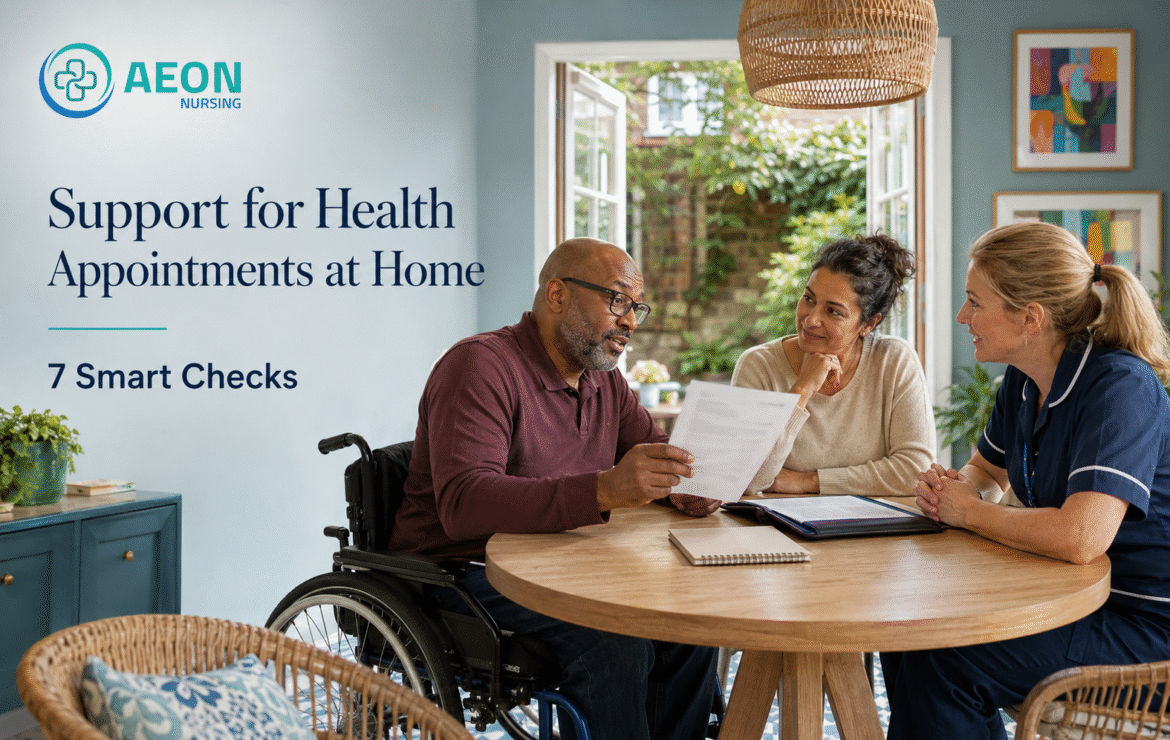
Support for health appointments at home starts well before a person leaves the house. For someone with complex needs, a routine appointment can involve transport, energy, mobility, communication, medication information, waiting times and decisions about who should be there. Good support makes the day more manageable without taking the appointment away from the person it is for.
The aim is not to choreograph every minute. It is to remove avoidable pressure, make information easier to access and protect the person’s choices. Sometimes that will mean a familiar supporter nearby; sometimes it will mean making space for a person to speak privately with a clinician. Both can be the right approach when the person leads the decision.
This guide is about practical preparation, not clinical advice. Appointment providers and the relevant clinician should be asked about medical questions, transport eligibility and any specific care requirement. If someone becomes acutely unwell or is in immediate danger, use the appropriate urgent or emergency route.
1. Begin support for health appointments at home with the person’s goal
Ask a simple question first: “What would help this appointment feel manageable?” The answer may be help organising information, travelling, taking breaks, asking questions, remembering what was said or having somebody familiar nearby. It may also be that the person wants some of the consultation to be private. Support works best when it is chosen, rather than assumed.
Write down what the person wants from the appointment and what they do not want. This could include a question they want answered, something they are worried about, or a preference for who speaks first. It also helps to agree how decisions will be made if plans change on the day. Aeon’s complex care for adults page gives helpful context on support that is built around individual needs rather than a one-size-fits-all routine.
Support for health appointments at home should strengthen a person’s involvement, not turn them into an observer in their own care. A supporter can make room for a person’s voice by helping them prepare, taking notes when asked, and allowing pauses instead of rushing to answer.
2. Make the appointment day realistic from door to door
An appointment may be booked for half an hour, but the day around it may be much longer. Check the location, journey time, accessible entrance, parking or transport options, likely waiting time and what will make the person comfortable. Think about the time needed to get ready, whether there should be a rest break before leaving, and what happens if transport is late.
The NHS has general information on going into hospital, including links to outpatient, transport and discharge guidance. For an individual arrangement, always confirm local details directly with the appointment provider; a previous visit is not proof that the same route, entrance or timing will work this time.
Where mobility, equipment or a specific support need is relevant, ask the right service what it can accommodate. Do not improvise a clinical or manual-handling solution from a blog article. The important practical test is whether the plan allows the person to arrive without being exhausted before the conversation has even started.
Good support for health appointments at home considers the person’s energy, timing and access needs before the journey becomes stressful.
3. Prepare a small information pack, not a pile of paperwork
Under pressure, a short factual note is often more helpful than trying to remember every detail. The person may want to take a list of questions, recent changes they want to mention, contact details for professionals already involved, and a current medicine list where it is appropriate. Keep it purposeful and only include information the person has agreed should be shared.
Ask the person whether they want a supporter to hold the notes, prompt a question or simply be available afterwards. The NHS medicines information pages can be a useful general reference, but staff at the appointment should be asked for advice that is specific to the person.
For support for health appointments at home, it also helps to decide what information needs to come back. A blank page headed “What happens next?” can be more valuable than a long set of notes. It gives the person and their supporters one clear place to record actions, dates and contact details.
4. Plan communication before arriving, not midway through the conversation
Appointments are more useful when staff understand how the person prefers information to be explained. That may mean one question at a time, written notes, extra processing time, a quieter space, an interpreter or a trusted supporter. Ask the provider in advance where possible, rather than relying on the person to negotiate every detail while they are already anxious or tired.
Communication support is about access, not about deciding for someone. The person may want a supporter to repeat a question, take notes or ask for clarification. They may not want a supporter to answer personal questions. Aeon’s communication support in home care guide includes practical ways of recording preferences so they travel with the care arrangement.
Good appointment support leaves room for silence and reflection. If an explanation is unclear, it is entirely reasonable to ask the clinician to repeat it in another way, write it down, or say what the next step means in practice.
For support for health appointments at home to work well, the person should be clear about who is present and how they can help.
5. Agree who will attend and what their role will be
Family involvement can be valuable, but it should be agreed rather than assumed. One person may be needed to help with the journey, another may be the person’s preferred note-taker, and there may be times when the person wants a private conversation. Clarifying this before the day helps protect dignity as well as reducing confusion at reception.
Be specific. Does the supporter accompany the person throughout, wait nearby, carry information, help with transport, or receive a summary only when the person agrees? Is a care worker attending as part of the agreed support arrangement? Care staff work within their role and the care plan; clinical questions and treatment decisions remain with the person and the appropriate clinician.
Aeon’s guide to families, NHS teams and care providers can help turn “someone will sort it” into clear responsibilities. That is often the difference between a supportive appointment and a stressful one.
6. Plan the return home and recovery time as carefully as the journey there
Leaving the appointment is not always the end of the task. The person may need a quieter journey home, food, a drink, rest, help to collect information or simply time to think. Avoid filling the rest of the day with demands if the appointment is likely to be tiring. A person should not have to choose between attending an important conversation and feeling safe and settled afterwards.
If the appointment results in a change to practical support, use the agreed review route. Aeon’s care-plan review at home guide can help families and providers translate new practical information into a clear conversation about day-to-day support. It is not for interpreting medical instructions; those should be clarified with the relevant clinical team.
Carers may also need space to reset. Carers UK’s help and advice includes information on practical support, planning ahead and looking after your own wellbeing. A sustainable arrangement recognises the effort that can sit around a single appointment.
7. Turn the follow-up into useful action, not an unanswered list
As soon as it feels appropriate, capture the next steps in plain English. What was agreed? Who is doing what? Is there another appointment? Is there a contact number or named team? Does the person want any information shared with their family or care provider? A short record helps avoid the familiar situation where everyone remembers the conversation slightly differently.
Support for health appointments at home is most useful when it connects the appointment to everyday life. A change may need a conversation with a provider, a family check-in, a review of transport or simply an agreed reminder. Record only what is relevant, respect the person’s choices about sharing information, and ask the clinical team whenever an instruction is unclear.
For wider quality questions about a home-care service, the Care Quality Commission’s guide to good home care gives a useful external reference point. It can help families compare broad promises with the everyday experience they should reasonably expect.
If the usual arrangement changes on the day, the last-minute cover information can help families ask how practical support will be communicated.
When plans are reviewed afterwards, support for health appointments at home can become more tailored and less tiring next time.
Frequently asked questions
Does support mean someone must attend every appointment?
No. The person should decide what would be helpful. Support can range from preparation at home to transport, note-taking, a familiar person nearby, or no one else in the consultation.
Can a care worker discuss treatment decisions?
No. Treatment and clinical decisions belong with the person and the appropriate clinician. A care worker may provide agreed practical support within their role.
What if the plan changes on the day?
Use the agreed contact route, explain the change clearly and seek the relevant professional advice if there is a clinical question. Do not rely on guesswork.
Over time, support for health appointments at home should become easier to organise because the person’s preferences are clear and the practical lessons from previous visits have been retained.
Talk through the options
Aeon Nursing can discuss practical support around a person’s routines, appointments and changing day-to-day needs. Contact Aeon Nursing to start a conversation.
Important information
Clinical review is required before publication. This article is general information only. It does not replace medical advice, an individual care plan, a clinical assessment or emergency services.
About the Author
Author & Content Writer: Dr Naeem Aslam
Last updated: August 2026
Write a Comment