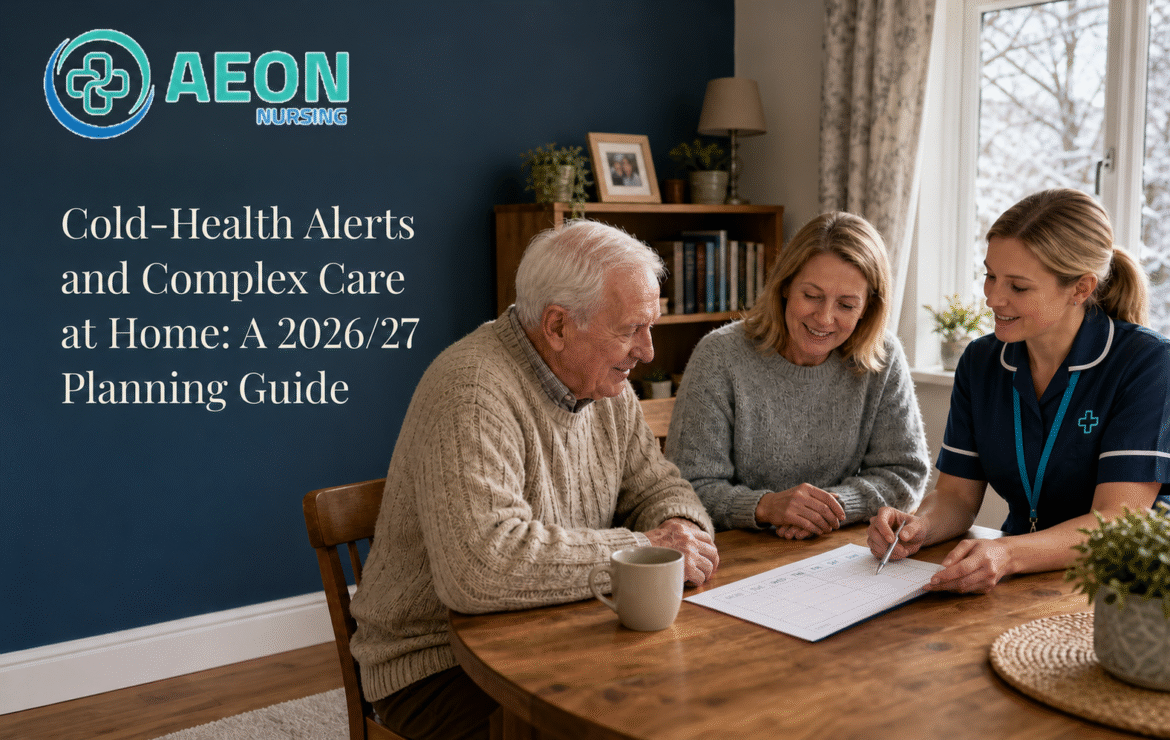
Cold-Health Alerts and Complex Care at Home: A 2026/27 Planning Guide

Cold-health alerts and complex care at home planning uses official weather-health information as a prompt to review an individual home-care plan. UKHSA and the Met Office issue Cold-Health Alerts when forecast conditions could have significant health impacts. Alerts use yellow, amber and red levels based on likelihood and impact.
An alert does not mean every person needs the same intervention, and this article does not invent a universal indoor-temperature or clinical rule. The response should follow the person’s assessed vulnerabilities, professional advice, current equipment, medicines arrangements and agreed escalation plan. Official alerts and dates must be checked live.
Cold-Health Alerts and Complex Care at Home: How the 2026/27 System Works
The UKHSA Cold-Health Alerting system overview explains that UKHSA and the Met Office monitor forecasts and conduct a joint risk assessment when adverse cold weather is predicted. Alerts can be yellow, amber or red, reflecting the combination of likely impact and likelihood.
The Adverse Weather and Health Plan 2026 to 2027 provides the wider national framework. The published operating periods and system details can be updated, and extraordinary alerts may occur outside the core season. Always use the current alert dashboard and publication, not a saved screenshot or last winter’s email.
The Cold-Health Alert action card for health and social care providers expressly includes services delivering care in people’s homes. Its suggested actions are prompts that organisations should apply through current professional judgement, individual assessments and established plans; not every action applies to every person or service.
Aeon Nursing’s home-care information can support a conversation about individual planning. It should not be presented as the official alert source or as a replacement for NHS advice.
Step 1: Check the Current Official Alert and Its Dates
Open the live UKHSA alert information and select the relevant region. Record the alert colour, issue time, start and end dates and any update. An alert can change as forecast impact and likelihood change, so identify who will recheck it and how new information reaches the care team.
The UKHSA weather-health alert dashboard displays current regional information. If no alert is shown, ordinary winter planning may still be necessary. If an alert is active, it is a trigger to review the person’s agreed plan rather than a diagnosis or automatic instruction.
For people receiving live-in care at home, agree who monitors updates and what happens at shift or rota handover. Do not assume the live-in worker is solely responsible for utilities, clinical advice or business continuity unless the written arrangement says so.
Step 2: Review the Person’s Individual Vulnerabilities and Advice
Use the current assessment and professional advice. Relevant factors may include age, mobility, respiratory or cardiovascular conditions, neurological needs, ability to communicate discomfort, medicines, nutrition, home condition, isolation, power dependence and access to transport. This list is not a risk score and cannot determine clinical vulnerability remotely.
Ask which professional advice already applies and whether cold weather changes any monitoring, equipment or appointment plan. Staff should not diagnose cold-related illness, recommend treatment or change prescribed arrangements. They should know what to observe and whom to contact.
Aeon’s pages on adult complex care and children’s complex care can help families identify topics for assessment. Individual actions must be confirmed in the care plan.
Step 3: Confirm Heating, Equipment and Essential Supplies
Check that heating and hot-water arrangements operate as expected, controls are understood and relevant contacts are current. Consider safe backup arrangements for a fault, but do not improvise with unsafe heating equipment. Identify who owns, pays for or repairs each item rather than assigning responsibility informally to a care worker.
For electrically powered care equipment, check charging, maintenance and power-cut instructions. Confirm which backup supplies exist, how long they are designed to operate and which service must be contacted. A provider should follow manufacturer and clinical instructions and should not promise continuity beyond verified capability.
Review essential food, fluids, continence products, prescribed supplies and safe access for deliveries. Planning should be proportionate; avoid stockpiling beyond professional advice, storage capacity or expiry dates. Record who checks and replenishes agreed items.
Step 4: Check Medicines and Agreed Clinical Arrangements
Cold weather may disrupt deliveries, appointments or access. Confirm current prescriptions, ordering responsibility, delivery or collection arrangements and what to do if a dose or supply is at risk. Workers must follow the medicine plan and seek advice rather than alter dosage or timing.
CQC’s Regulation 12 guidance concerns safe care and treatment, including risk and medicines responsibilities. For each package, staff need task-specific instructions, competence and access to professional advice.
Check whether appointments, therapies, feeding plans, respiratory support or other clinical arrangements have weather-related contingencies. The responsible clinician or service should confirm any change. A home-care provider can support authorised coordination but should not create a new clinical plan.
Step 5: Reconfirm Contacts, Visits and Communication Routes
Verify telephone numbers for the person, chosen family contacts, provider, GP or responsible clinical team, utilities, equipment service and urgent or emergency routes. Note which contact applies to which problem. A long unprioritised list can delay action.
Review how severe weather could affect travel and staffing. Ask what the provider’s current business-continuity process covers, how delay or change will be communicated and which responsibilities remain with commissioners or other services. Do not describe a contingency as guaranteed unless it is evidenced for the package.
Aeon describes its clinical expertise and oversight online. Before publication, Aeon must confirm how cold-weather concerns and operational disruption are actually escalated, without inventing response times.
Step 6: Record What Changes at Each Agreed Risk Level
The individual plan can state what is checked routinely, what is reconsidered when an alert affects the region and what professional advice is required before a clinical change. Avoid copying the national action cards into a personal care plan without deciding which actions are relevant and who is responsible.
Record the alert checked, date, agreed action, owner and review time. If no change is needed, record that the plan was reviewed rather than leaving uncertainty. Replace outdated instructions across the active record and communicate them to authorised staff.
Link this focused alert response to the person’s wider winter care plan. The Aeon Nursing articles hub may carry broader preparation content, while this guide remains concerned with official alert response and continuity checks.
Step 7: Escalate Concerns Through the Person’s Approved Pathway
Workers should recognise and report changes using the person’s documented pathway. They should not diagnose hypothermia, respiratory deterioration or another condition through this article. Seek clinical advice through the agreed NHS route, and use 999 for a life-threatening emergency.
Escalation records should state observations, timing, action taken, advice received and the person informed. If travel or communications fail, follow the verified contingency rather than relying on an informal expectation that a family member will intervene.
After the alert ends, review unresolved effects: missed appointments, depleted supplies, equipment issues, delayed records or new professional advice. Closing the alert without closing these actions can leave risks in the next period of cold weather.
What the Alert Colour Does and Does Not Tell You
The colour communicates a combined assessment of expected health impact and likelihood across a region. It helps public bodies, health and social-care services and communities prepare. It does not tell a family exactly how one person will respond or prescribe a universal change to their care.
Do not create an Aeon temperature threshold, clinical observation schedule or escalation rule unless a qualified source and individual plan support it. Where national advice offers general protective actions, apply them through the person’s assessment and professional guidance.
The following review prompts summarise how an organisation may translate the alert position into person-specific planning. They are not universal care or clinical instructions.
| Alert position | Person-specific planning prompt |
|---|---|
| Green or no alert | Keep routine winter readiness, contacts and agreed contingency arrangements current. |
| Yellow | Read the full regional alert and review which forecast impacts may affect the individual plan. |
| Amber | Recheck the continuity, staffing, equipment, supplies, communication and escalation arrangements already identified for the person. |
| Red | Follow established emergency-response arrangements and current official or professional instructions; do not assume every person requires the same action. |
Preparation Before an Alert Is Issued
The safest time to resolve basic responsibilities is before an alert. Review the winter section of the care plan, current contacts, heating controls, equipment instructions, power-failure arrangements, medicine supply route, staff travel contingencies and the person’s communication needs. Identify gaps that need a landlord, utility company, equipment supplier, commissioner or clinician.
Confirm which alerts or planner communications the organisation monitors and who covers that task during leave or out of hours. Subscribe through the official route where appropriate and keep the regional setting current. A screenshot from last winter should not remain the trigger for a live care decision.
Check practical access to the home. Severe weather can affect paths, keys, transport and deliveries. Agree who can safely clear or report an access problem, how workers communicate delay and which alternative action has been authorised. Do not instruct staff or family members to take unsafe travel or manual-handling risks.
Where the person relies on power-dependent equipment or tightly timed clinical input, obtain plan-specific contingency advice from the responsible service. Record realistic backup duration, escalation thresholds supplied by the appropriate professional and what happens if several services are disrupted at once.
Handover During an Active Cold-Health Alert
A handover should state the live alert and dates, the person-specific checks completed, any authorised plan change, outstanding action and who will next review the alert. Avoid a generic message such as “amber alert—keep warm” when the team needs task-level information.
Separate observation from interpretation. Staff can record that the home felt colder than usual, a heating fault was reported, equipment lost power, a delivery did not arrive or the person described a symptom. Clinical interpretation and treatment advice must come through the authorised route.
If a visit is delayed or changed, record the reason, person informed, immediate risk check, alternative arrangement and escalation. The family should not discover a gap only when a worker fails to arrive. Equally, communication must not promise a replacement or arrival time before it is confirmed.
Where different agencies support the person, decide which organisation coordinates each action. A care provider, district nursing service, equipment supplier and commissioner may all hold responsibilities. The plan should prevent duplication and gaps while respecting consent and information-governance limits.
Learning After the Weather Event
Review what worked and what did not. Check alert monitoring, communication, rota continuity, equipment, medicines and supply access, professional contacts and the person’s experience. A near miss or improvised solution should become an action rather than being forgotten once the weather improves.
Update the plan, contact list and business-continuity arrangements with verified changes. Identify who owns the improvement and when it will be tested. The goal is not to promise that disruption will never happen; it is to make responsibilities and escalation more reliable before the next alert.
Include the person and those they choose in the review. Ask whether communications were timely and understandable, whether the home remained comfortable, whether routines or choices were unnecessarily restricted and what they want changed. Operational learning should not focus only on whether scheduled visits were completed.
Where the event affected staff, suppliers or partner services, compare records and timelines without sharing more personal information than necessary. Agree one updated version of the relevant instructions and retire superseded copies through the organisation’s records process.
Cold-Health Alerts and Complex Care at Home: Post-Alert Record
A review of cold-health alerts and complex care at home should close the loop after the alert changes or ends. The record should show what information was actually used, what happened to planned care and which unresolved matters still need an owner. It should not turn a regional alert into a retrospective clinical judgement about the person.
- Alert details: record the region, level, issue time, start and end dates, and the latest update used.
- Care continuity: note completed, delayed or rearranged visits and the authorised response to any disruption.
- Equipment and utilities: record confirmed faults, supply issues, backup use and contacts made through the agreed route.
- Health information: separate observations and reported symptoms from clinical conclusions, and record escalation accurately.
- Communication: note information shared with consent, accessible formats used and any handover still outstanding.
- Follow-up: assign an owner and review date for supplies, appointments, records, staffing or professional advice that remains unresolved.
The post-alert review should remain proportionate and factual. If a concern remains active, continue through the person’s current escalation plan and obtain advice from the responsible service. The alert colour does not replace individual assessment, and a life-threatening emergency still requires 999.
Seven Questions for a Cold-Weather Plan Review
- Which official alert applies to our region, and when will it be checked again?
- Which individual vulnerabilities and professional instructions matter?
- Are heating, power-dependent equipment and backup arrangements verified?
- Are essential medicines and supplies available within the agreed plan?
- How will visits, delays and changes be communicated?
- What actions are authorised at each agreed level, and who owns them?
- Which NHS, provider and emergency route applies to each concern?
How Aeon Nursing May Help
Aeon Nursing may be able to review practical cold-weather considerations within an individual home-care arrangement, follow an agreed plan, communicate authorised changes and use the package’s escalation routes. Its exact responsibility must be confirmed for the person and service.
Aeon is not the issuer of Cold-Health Alerts and does not replace UKHSA, the Met Office or NHS clinical advice. Families should use the official dashboard for current alert information.
Frequently Asked Questions
What is a Cold-Health Alert?
It is an official alert issued through the UKHSA and Met Office system when forecast cold weather could have significant health impacts. Levels reflect expected impact and likelihood and apply regionally.
Does an alert mean every care plan should change in the same way?
No. It should prompt review. Individual action depends on assessed needs, professional advice, home and equipment arrangements, the existing care plan and the specific alert information.
What practical arrangements should families confirm?
Confirm the live alert, heating, equipment, power backup, essential supplies, medicines arrangements, contacts, visits, communication, authorised actions and escalation routes relevant to the individual plan.
Where should changing health concerns be escalated?
Use the person’s approved clinical and provider pathway. Contact NHS services as directed in the plan and call 999 for a life-threatening emergency. Home-care workers should not diagnose or change treatment independently.
Talk Through the Winter Planning Questions
Contact Aeon Nursing to discuss cold-weather planning questions within a proposed or existing home-care arrangement. Keep the current care plan, equipment instructions and relevant professional contacts available so responsibilities can be verified.
Important Information
Registered clinician and business-continuity review are required before publication. This article provides general information for England from official sources checked on 14 August 2026. It is not clinical, legal, emergency, equipment, utilities or individual risk advice. Alert details and plans can change; check UKHSA’s live dashboard and obtain current advice from the responsible qualified professionals. Call 999 for a life-threatening emergency.
About the Author
Author & Content Writer: Dr Naeem Aslam
Last updated: August 2026
Write a Comment