7 Essential Questions Before Arranging Complex Care at Home

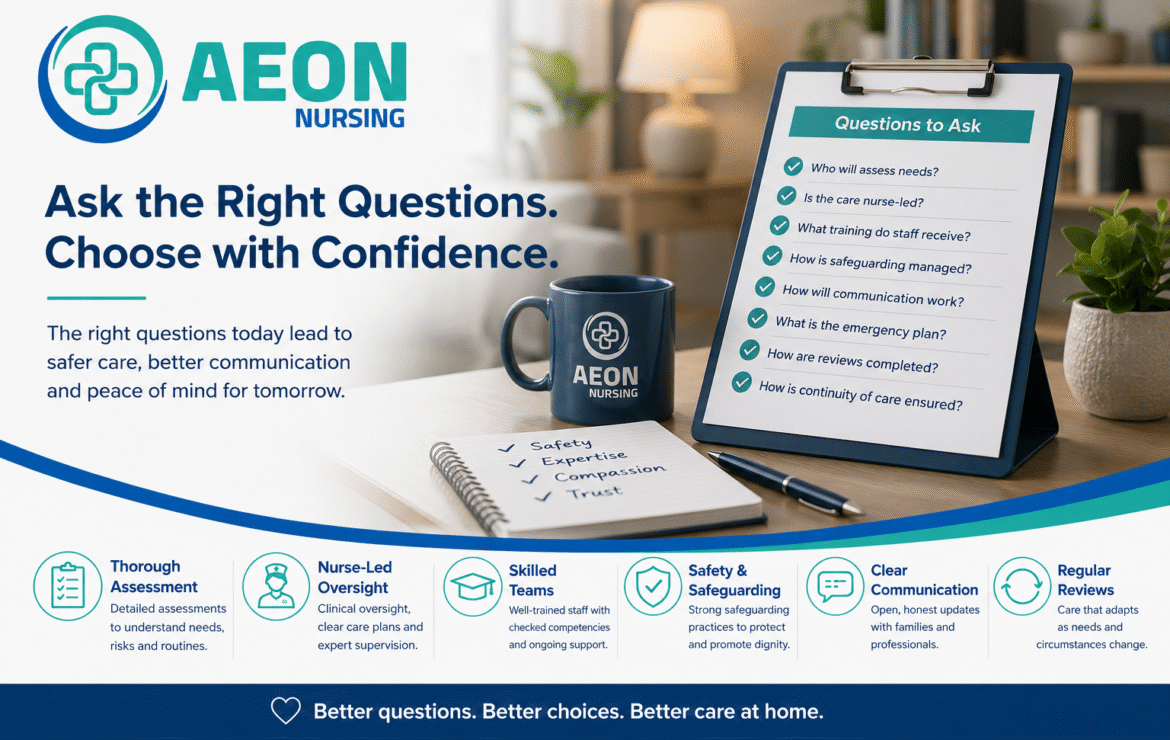
The most useful questions before arranging complex care at home are the ones that reveal how a proposed service will work in real life. Families need more than reassuring promises. They need to understand the assessment, staffing, care plan, communication, safeguards, costs and review process before support begins.
This can be difficult when a relative is leaving hospital, needs have changed quickly or several organisations are involved. A family may be speaking with ward staff, community professionals, an NHS team, social care and several providers at the same time. Writing down the same core questions for every conversation can make comparisons clearer.
Complex care may involve serious or changing health needs, specialist routines, equipment, mobility support, nutrition, medicines or input from several professionals. The right questions will depend on the person. This guide provides seven structured checks to help families organise the discussion without trying to make clinical or funding decisions alone.
This article is general information. It does not replace an individual assessment, clinical advice, legal advice or a formal funding decision.
Step 1: Ask Who Will Assess the Person’s Needs
The first of the seven questions before arranging complex care at home is: who will assess the person, and what will that assessment cover? A short telephone conversation can establish basic facts, but a complex package normally requires a fuller understanding of the person, their home, routines, risks and professional support.
Ask who leads the provider’s assessment and what qualifications or experience are appropriate for the needs involved. Find out whether the assessor will speak with the person receiving care, family members chosen by them, hospital or community professionals and anyone responsible for an existing clinical plan.
A useful assessment should distinguish between what the provider can deliver, what requires clinical oversight and what remains the responsibility of an NHS or other professional team. It should consider communication, consent, mobility, medicines, nutrition, personal care, equipment, night-time needs, the home environment and what happens if needs change.
The person should be involved as fully as possible. The NICE recommendations on shared decision making emphasise clear information, discussion of options and involvement of the people the individual wants included. Ask how the assessor will adapt the conversation if the person uses a communication aid, needs an interpreter or requires information in another format.
For a clearer explanation of the overall care model, read our guide to what complex care at home means for families. It can help you decide which parts of the assessment need specialist discussion.
Step 2: Ask About Staff Skills, Training and Oversight
Do not ask only whether staff are “trained.” Ask which competencies are required for this person’s package, how they are checked and who provides ongoing supervision. Training should match the assessed care plan rather than rely on a generic course list.
Useful questions include:
- What experience will staff need for this package?
- Which tasks require person-specific competency assessment?
- Who signs staff off as competent and how is competence reviewed?
- What clinical oversight is available to the care team?
- How are new or replacement staff introduced to the person and the plan?
- What happens if a suitable worker is unavailable?
Ask how the provider avoids placing a worker into a complex package before they understand the individual routines, equipment, risks and escalation steps. A staff member may have relevant general experience and still need a package-specific briefing or supervised introduction.
Our article on nurse-led complex care and professional oversight explains why leadership and review matter alongside day-to-day support. Families can also explore training, governance and safeguarding in complex home care before speaking with a provider.
Listen for specific answers. “All our staff are fully trained” is less useful than an explanation of the competencies, assessment process, supervision and contingency plan that would apply to this individual.
Step 3: Ask How the Care Plan and Risk Plan Will Work
A care plan should translate the assessment into clear daily instructions. Ask who writes it, who approves it, how the person and family contribute and how quickly it can be updated. Staff should be able to access the current version when providing care.
The plan should describe routines, preferences, agreed outcomes, support tasks and relevant professional instructions. It should also explain what staff must observe, record or report. Risk planning should support the person safely without removing choice unnecessarily.
Ask how the provider handles areas that depend on another professional plan. For example, a hospital discharge summary, medication record, nutrition plan, moving and handling assessment or seizure plan may need to inform home-care instructions. The provider should not rewrite clinical guidance outside its authority, and families should not be expected to reconcile conflicting versions alone.
Questions to ask include:
- Will we receive or be able to review the written care plan?
- How are the person’s routines, communication and preferences recorded?
- What are the agreed escalation steps?
- Who updates the plan after a hospital appointment or change in needs?
- How will staff know that they are using the latest version?
- When is the first formal review?
Where care follows a hospital stay, our hospital-to-home checklist for complex patients can help families organise equipment, information, medicines and contacts before discharge.
Step 4: Ask About Communication and Escalation
Clear communication reduces the chance that a family becomes the only link between every service. Ask who the main provider contact will be, how routine updates are shared and what number is used outside normal office hours.
The plan should distinguish routine questions from urgent clinical concerns and emergencies. Families need to know who staff will contact, when the family is informed and when NHS or emergency help may be required. General website information cannot replace the person-specific escalation instructions provided by the professionals involved.
Ask how staff record changes and how those observations reach the right person. If a worker notices reduced mobility, new discomfort, a change in communication or difficulty with an established routine, there should be a clear reporting route. The provider should explain how it responds within its scope and when it seeks input from another professional.
Communication must include the person receiving care. Find out how information will be explained accessibly and how consent or choice is recorded. Ask what happens if the person and family have different views, and how confidentiality is managed.
One of the practical questions before arranging complex care at home is therefore: “Can you show us who communicates with whom when something changes?” A simple named-contact map is often more useful than a general promise to keep everyone updated.
Step 5: Ask About Safeguarding, Concerns and Complaints
A responsible provider should welcome reasonable questions about safeguarding and complaints. Ask how staff recognise and report concerns, who the safeguarding lead is and how the person receiving care is protected while a concern is reviewed.
Families should understand the difference between everyday feedback, a formal complaint, a safeguarding concern and an emergency. The provider should explain each route without becoming defensive. It should also explain how people can raise issues in an accessible way.
Ask how incidents are recorded, investigated and used to improve care. Find out how you will be informed, subject to confidentiality and the person’s wishes. Ask what happens if the concern relates to a regular member of staff or a manager.
The CQC description of a good home-care agency gives families a useful independent reference point. It covers safety, staff skills, personalised planning, involvement in decisions and how concerns should be taken seriously.
Red flags include vague answers about reporting, pressure not to complain, an inability to explain who supervises staff, or promises that incidents never happen. A safer answer recognises that concerns must be reported, addressed openly and learned from.
Step 6: Ask About Costs, Funding and What Is Included
Request a written explanation of the proposed package and charges. Ask what is included in the quoted rate, what may cost extra and how changes in hours, staffing or clinical requirements affect the price. Clarify notice periods, cancellation arrangements and what happens if care cannot be delivered as planned.
Do not assume that one headline price can be compared directly with another. Providers may be describing different staffing levels, hours, responsibilities or contingency arrangements. Compare the actual plan rather than the label attached to it.
Families can ask the local authority for a health and social-care needs assessment. The assessment helps identify what support may be needed, but it does not guarantee a particular service or funding outcome. A separate financial assessment may apply.
Some adults with complex ongoing healthcare needs may be eligible for NHS Continuing Healthcare. The NHS Continuing Healthcare guidance explains that eligibility depends on an assessment of needs rather than diagnosis alone. A provider should not promise that a family will qualify or claim to control the NHS decision.
Our overview of complex care at home costs in the UK provides additional questions to organise before comparing packages. Ask the relevant NHS or local-authority team for individual funding advice.
Step 7: Compare the Answers and Agree the Next Step
After speaking with providers, compare answers under the same headings: assessment, staffing, oversight, care planning, communication, safeguards, cost and review. Written notes reduce the risk of choosing only from memory after an emotional conversation.
Look for answers that are person-specific, clear and realistic. A provider should be able to explain its scope, identify where another professional must contribute and avoid guarantees that depend on events outside its control. It should give the family time to understand the proposed arrangement.
Consider how the conversation felt. Were staff interested in the person or mainly focused on filling available hours? Did they ask about communication, culture, routines and goals? Did they explain limitations? Did they welcome questions?
Our article on inclusive and culturally sensitive care at home offers additional prompts about identity, communication and personal preferences. These points belong in complex-care planning as well as in ordinary homecare.
The final one of these questions before arranging complex care at home is: “What must happen before care can start safely?” The answer may involve another assessment, equipment, staff competency checks, information from a clinical team or a clearer agreement about funding. A careful start is more valuable than a rushed promise.
Frequently Asked Questions
How many providers should a family speak to?
There is no fixed number. Speaking with more than one provider can help comparison, but suitability and timing may limit the options. Use the same core questions and compare the proposed care package, not only the hourly or weekly price.
Should a provider assess the person at home?
The appropriate assessment format depends on the situation. For a complex package, understanding the home, equipment, routines and people involved may be important. Ask the provider how it will obtain enough information to plan safely and which professionals need to contribute.
Can a provider guarantee that hospital admission will be avoided?
No provider can responsibly guarantee that a person will never need hospital care. Ask instead how staff monitor the agreed plan, report concerns and follow escalation instructions. Emergencies and clinical decisions remain subject to the appropriate professional response.
What if the family does not understand the proposed care plan?
Ask for it to be explained in plain language and an accessible format. Write down unresolved questions. Do not feel pressured to agree until the person and those supporting them understand the responsibilities, limitations, costs and next steps.
Can the care package change after it starts?
Yes, needs and circumstances can change. Ask how reviews are requested, who reassesses the package and how staffing, cost and professional input may be affected. Urgent changes should follow the person-specific contact and escalation plan.
Talk Through the Options
Aeon Nursing can discuss the complex home-care support it may be able to provide for adults or children, subject to assessment and service suitability. Bring your written questions before arranging complex care at home and any current professional plans you are authorised to share.
The discussion should help clarify the next step, which may be a fuller assessment, liaison with an existing team, confirmation of staffing requirements or further information about the proposed package.
Planning a Sustainable Arrangement
Before care starts, create one practical summary of the week. Include current professional appointments, family support, equipment, key routines, night-time needs and the periods when support is most important. This helps everyone discuss the same reality.
Keep a question sheet beside that summary. Give each question a space for the answer, the name and role of the person who answered it, and any follow-up action. This prevents a reassuring conversation from becoming difficult to recall later and makes it easier to spot where different organisations have given conflicting information.
Ask for important parts of the proposal in writing. This may include the assessed hours, staffing model, tasks within scope, start arrangements, charges, notice periods and review process. Read the documents together with the person receiving care where possible, and request an accessible version if the standard format does not meet their communication needs.
Consider the effect on the household as well as the formal package. Discuss privacy, staff access, space for equipment, rest arrangements, pets, family routines and how visitors will fit around care. A plan may look complete on paper but still need adjustment before it is workable in the person’s home.
Finally, separate unresolved questions into categories. Clinical questions should go to the appropriate health professional; funding questions to the relevant NHS or local-authority team; and service-delivery questions to the provider. This reduces confusion and helps each organisation answer within its responsibility.
Keep the completed question sheet with the agreed care documents so it can support the first review. Confirm which answers remain provisional and which have been formally agreed by the responsible organisation.
Agree named contacts and boundaries. Families should know who to call, but should not become responsible for coordinating clinical decisions beyond their role. Providers should know which professional plan applies and where to seek clarification.
Plan for ordinary disruption. Ask what happens when a worker is ill, an appointment changes, equipment is delayed or the person’s routine does not match the original assessment. A sustainable package needs a clear contingency process.
Set an early review date and write down what will be checked. Include the person’s experience, staff suitability, communication, task delivery, risks and whether the package still reflects assessed needs. Reviewing a new arrangement is a normal part of establishing safe support.
Important Information
This article is for general information only. It does not replace medical advice, a clinical assessment, a care needs assessment, legal advice, safeguarding advice or an NHS or local-authority funding decision. Complex care should reflect the person’s assessed needs, consent, professional plans and changing circumstances.
If someone appears to be in immediate danger or has a life-threatening emergency, call 999. For non-emergency changes or concerns, use the contact and escalation arrangements provided by the person’s health or care team.
About the Author
Author & Content Writer: Dr Naeem Aslam
Last updated: July 2026
Write a Comment