Training, Governance and Safeguarding: 7 Essential Checks for Safe Care

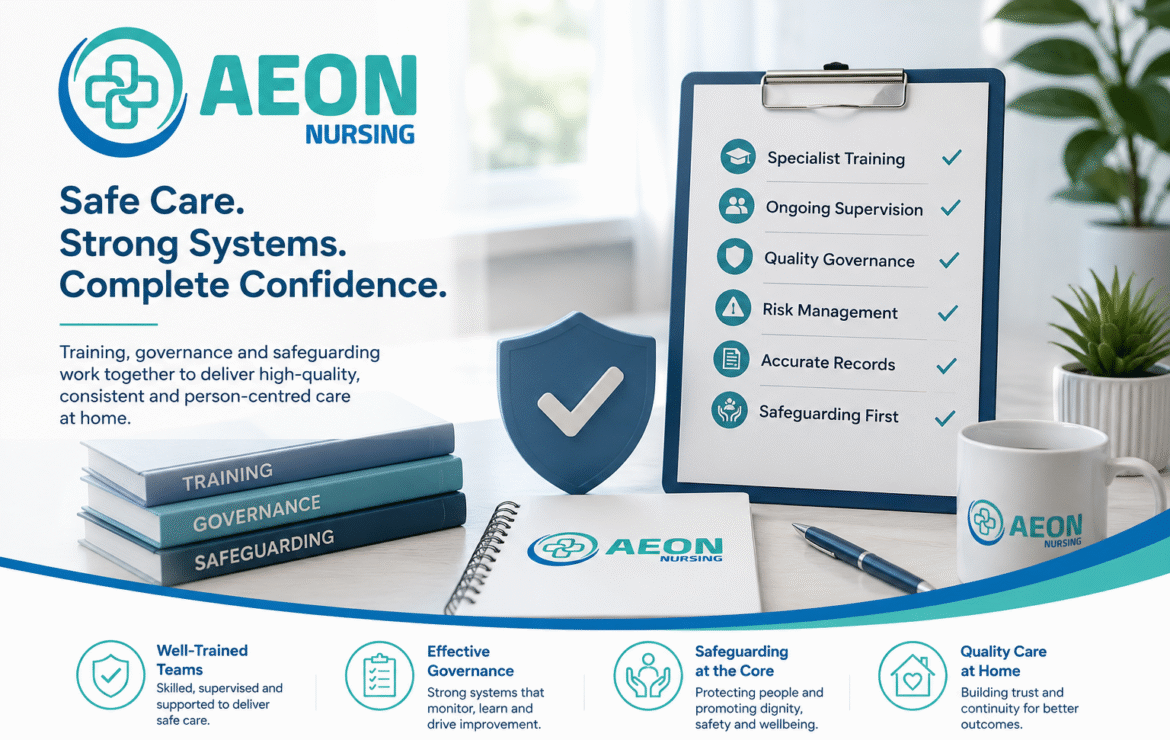
Training, governance and safeguarding are the systems that turn a promise of good home care into safe, consistent practice. Families naturally notice whether staff are kind, punctual and respectful. When needs are complex, they also need confidence that the people providing support have been prepared for the individual care plan, that concerns are reviewed properly and that everyone knows how to respond if something changes.
These three areas are connected. Training helps staff understand what to do and why it matters. Governance checks whether plans, records, supervision and outcomes are working in practice. Safeguarding creates clear routes for preventing, recognising and reporting abuse, neglect or avoidable harm. One element cannot reliably compensate for another, so families should look at the whole safety system.
This does not mean relatives need to become inspectors or clinical managers. It means asking calm, practical questions and expecting answers that relate to the person rather than a generic company brochure. The right evidence will vary according to the care package, but it should be possible to explain who oversees the plan, how competence is checked, how incidents are learned from and how the person can raise a concern.
The seven checks below provide a repeatable way to discuss complex care at home safety with a provider. They are designed to complement a proper assessment and professional advice, not replace them. Families who are still clarifying the type of support required may first want to read what complex care at home involves before comparing governance arrangements.
Step 1: Connect Training, Governance and Safeguarding to the Care Plan
The starting point is the individual care plan. Training governance and safeguarding should not sit in separate folders that have little connection with daily support. They should help staff deliver the person’s agreed routines, understand identified risks and protect the person’s preferences, dignity and rights. Ask the provider to explain how its wider systems are translated into this particular package of care.
A useful answer should distinguish between general induction and person-specific preparation. General learning may cover communication, moving and handling, infection prevention, medication awareness, equality, consent and safeguarding. Person-specific preparation should address the assessed needs, equipment, routines, escalation instructions and outcomes documented for the individual. The required mix depends on the role and the care plan.
The plan should also make responsibilities clear. Families need to know what trained care staff will do, what requires a registered professional, what relatives have agreed to support and who should be contacted for advice. Clear boundaries protect everyone. They reduce the risk of an important task being assumed, duplicated or passed informally to a family member who has not accepted it.
- Ask which parts of the care plan require specific knowledge or assessed competence.
- Confirm who owns each action, review and escalation decision.
- Check how changes to the plan are communicated before staff work differently.
Step 2: Match Staff Training to Complex Care at Home Safety
A list of course titles is not enough on its own. The important question is whether staff have the knowledge and practical ability needed for the tasks they are expected to perform. The CQC staffing requirements under Regulation 18 describe the need for suitably qualified, competent, skilled and experienced staff, together with appropriate support, training and supervision.
For a complex package, preparation may include shadowing, supervised practice, observation and a documented competency decision. The exact method should be proportionate to the person’s needs and the task. Families can ask who assesses competence, what evidence is recorded and what happens if a worker does not yet meet the required standard. A credible provider should be comfortable explaining that process without sharing confidential staff information.
Training should also be refreshed when evidence, equipment, professional instructions or the person’s condition changes. A certificate completed months earlier cannot show that someone understands a new care plan. Good complex care at home safety depends on staff being able to apply learning consistently during real shifts, including when the situation is unusual or additional support is needed.
- Separate attendance at training from demonstrated competence in practice.
- Ask who observes staff and signs off person-specific skills.
- Confirm how refresher learning and changed instructions are managed.
Step 3: Plan Support and Escalation for Complex Care at Home Safety
Competent staff still need accessible support. Home care workers often make observations without a colleague standing beside them, so they need a reliable way to ask questions and report changes. Ask who provides day-to-day guidance, whether help is available outside normal office hours and how the provider decides when a concern needs clinical, managerial or emergency escalation.
Supervision should connect policies with practice. It can be used to review records, discuss difficult situations, identify learning needs and check whether the worker understands the person’s current plan. Where the package is nurse-led, families can also ask how nursing oversight relates to the care team and to other professionals involved in the person’s support. Aeon’s explanation of nurse-led complex care provides useful context for that discussion.
Escalation routes should be specific enough to use. Staff need to recognise when a change can be documented for review, when a manager or clinician should be contacted promptly and when emergency services are required. The care plan must reflect professional instructions and should not encourage staff to make decisions outside their competence or role.
- Identify the named operational and clinical contacts for the package.
- Ask how workers obtain urgent advice during evenings, nights and weekends.
- Check that escalation instructions are current, accessible and understood.
Step 4: Examine Care Governance UK Records and Reviews
Care governance UK requirements become visible through records, reviews and decisions. The purpose is not paperwork for its own sake. Accurate records help the team understand what support was delivered, what changed, what action followed and whether the care plan remains suitable. Weak records make it harder to identify patterns or investigate concerns fairly.
The CQC good-governance requirements in Regulation 17 cover effective systems for assessing, monitoring and improving quality and safety. Families can translate that into practical questions: how are missed or late visits reviewed, how are incidents investigated, how is feedback recorded and who checks whether agreed improvements actually happen?
Governance should include learning as well as reporting. If a problem occurs, the response should look beyond the immediate event and consider whether the plan, communication, staffing, training or oversight needs to change. A provider’s care compliance checklist can help families understand the kinds of evidence worth discussing, while the individual package still needs its own controls.
- Ask how daily records, incidents, complaints and audits are reviewed together.
- Confirm who approves changes following a governance review.
- Look for evidence that actions are completed and checked, not merely recorded.
Step 5: Test Safeguarding Within Care Governance UK
Safeguarding is everyone’s responsibility, but responsibility must be supported by a clear process. Staff should know how to recognise possible abuse or neglect, how to respond without increasing risk and where to report a concern. The person receiving care and their family should also know how to speak up, including how to contact someone outside the immediate care team when appropriate.
The CQC safeguarding requirements in Regulation 13 state that people must be protected from abuse and improper treatment. In practice, a provider should be able to explain its safeguarding lead arrangements, reporting route, record keeping, staff learning and cooperation with local authority or other statutory processes when a concern requires it.
A healthy safeguarding culture does not discourage questions because they feel uncomfortable. It welcomes proportionate scrutiny, supports whistleblowing and treats the person’s voice seriously. Families should be cautious if concerns are minimised, explained away before being reviewed or routed only through the person whose conduct is being questioned.
- Write down the provider’s safeguarding and out-of-hours contact routes.
- Ask how the person can raise a concern in an accessible way.
- Confirm that staff know how to report concerns outside their immediate line.
Step 6: Check Continuity, Communication and Shared Accountability
Training governance and safeguarding can fail if information is fragmented. Complex home care may involve relatives, care workers, nurses, therapists, GPs, community teams or commissioners. Each participant has a different role, so the arrangement needs clear communication rules, consent boundaries and a shared understanding of which plan is current.
Continuity matters because familiar staff are more likely to recognise subtle changes in routines, behaviour or wellbeing. At the same time, the service must remain safe when a regular worker is unavailable. Ask how replacement staff are briefed, how competence is checked and how the person is introduced to changes. The guide to family, NHS and provider teamwork in complex home care explains why named contacts and shared responsibilities help.
Families should not become the default communication system between organisations. They can contribute valuable knowledge and participate when the person wants them involved, but professional teams remain responsible for their own records, decisions and handovers. Clear accountability reduces pressure on relatives and makes it easier to identify the right contact when something needs attention.
- Agree which record or plan is treated as the current source of truth.
- Confirm how replacement staff receive a safe and timely handover.
- Set consent-aware routes for routine updates, urgent concerns and formal reviews.
Step 7: Review Training Governance and Safeguarding Over Time
The final check is whether the system continues to work. A safe starting plan is important, but health, family circumstances, equipment and staffing can change. Reviews should consider the person’s outcomes and experience as well as whether tasks were completed. They should also identify whether new training, a revised risk plan or different professional input is needed.
The NICE home care recommendations cover person-centred planning, coordination, records, safety, safeguarding and staff development. Families can use those themes to organise review questions without treating guidance as a substitute for the person’s professional assessment. The focus should remain on how safely and respectfully the actual package is working.
Reviews are especially important after a hospital admission, a significant change in health, a safeguarding concern, repeated staffing disruption or a change in equipment or professional instructions. Aeon’s hospital-to-home checklist for complex patients highlights why preparation and handover need attention during transitions.
- Set routine review points and clear triggers for an earlier review.
- Include the person’s feedback and the observations of agreed family members.
- Record actions, owners and deadlines, then confirm that changes were completed.
Frequently Asked Questions
What should families ask about staff training before complex home care begins?
Ask which skills are required for the individual plan, who provides the learning, how practical competence is assessed and how staff are supervised afterwards. It is also reasonable to ask how replacement workers are prepared and how changes to equipment, risks or professional instructions trigger refreshed learning.
What does governance mean in day-to-day home care?
Governance is the set of systems used to monitor and improve the service. It includes care planning, record quality, audits, incident and complaint review, staffing oversight, supervision, risk management and follow-through on agreed actions. Good governance should make daily care clearer and safer, not simply create extra paperwork.
Who should a family contact about a safeguarding concern?
Use the provider’s safeguarding route and follow any local authority or emergency guidance relevant to the situation. If someone is in immediate danger, contact emergency services. Families should be given accessible contact details and should not be expected to route a concern only through the person involved in it.
Does training guarantee that a care package will be safe?
No single certificate can guarantee safety. Training needs to be combined with appropriate recruitment, assessed competence, a clear care plan, supervision, effective governance, safeguarding practice and timely review. Safety also depends on honest communication and action when the person’s needs or circumstances change.
Talk Through the Options
If you are comparing complex care providers, ask each one to explain how its training governance and safeguarding arrangements would work for the person you support. Use the same core questions so that answers can be compared fairly. Request clarification where language is vague, and take time to involve the person receiving care in the way that suits their communication and decision-making needs.
Aeon Nursing can discuss how assessment, nurse-led oversight, staff preparation and review may fit a proposed home care arrangement. For a no-obligation conversation, contact the team at info@aeonnursing.co.uk. A discussion is not a substitute for clinical, legal or safeguarding advice, but it can help families identify the next practical questions.
Planning a Sustainable Arrangement
A sustainable arrangement needs more than enough staff for the first week. It should include a realistic rota, competent backup, accessible escalation, reliable records and regular opportunities to review outcomes. Families may also want to explore how the provider approaches changing physical and mental health needs; the article on supporting complex physical and mental health needs together offers further context.
Before care begins, write down the named contacts, review date, urgent escalation process and any decisions that still depend on assessment or funding. Keeping this information together reduces uncertainty. It also gives the person, family and professionals a clear baseline against which to judge whether care remains safe, respectful and dependable.
When a provider explains care governance UK arrangements, ask for examples of how oversight changes practice without requesting confidential information. A useful example might show how an audit, incident review or staff observation led to clearer instructions, refreshed learning or a revised review schedule. This helps families distinguish an active governance system from policies that are rarely used.
Complex care at home safety also depends on the household understanding the agreed boundaries. Keep emergency contacts visible, ensure relatives know which concerns belong to the provider and record who will update outside professionals. Training governance and safeguarding work best when the person, family and staff can all recognise the right route without having to improvise during a difficult moment.
During the provider discussion, ask how the same standards will be maintained when the rota, manager or external professionals change. A resilient system should not depend on one person remembering every detail. Current plans, recorded competence, accessible contacts and scheduled reviews allow training governance and safeguarding to continue consistently through ordinary staffing changes and unexpected events.
Important Information
This article provides general information about training governance and safeguarding in home care. It does not replace an individual clinical assessment, a safeguarding decision, legal advice, local authority guidance or the instructions of regulated professionals. Required training and oversight depend on the person’s needs, the tasks being delivered and the responsibilities of the organisations involved.
If you believe someone is in immediate danger, contact the emergency services. Safeguarding concerns should be reported through the appropriate provider and local authority routes. Care plans and risk controls should be created and reviewed by people with the relevant authority and competence.
About the Author
Content Writer: Dr Naeem Aslam
Write a Comment