Complex Care Assessment at Home: 7 Safe Checks

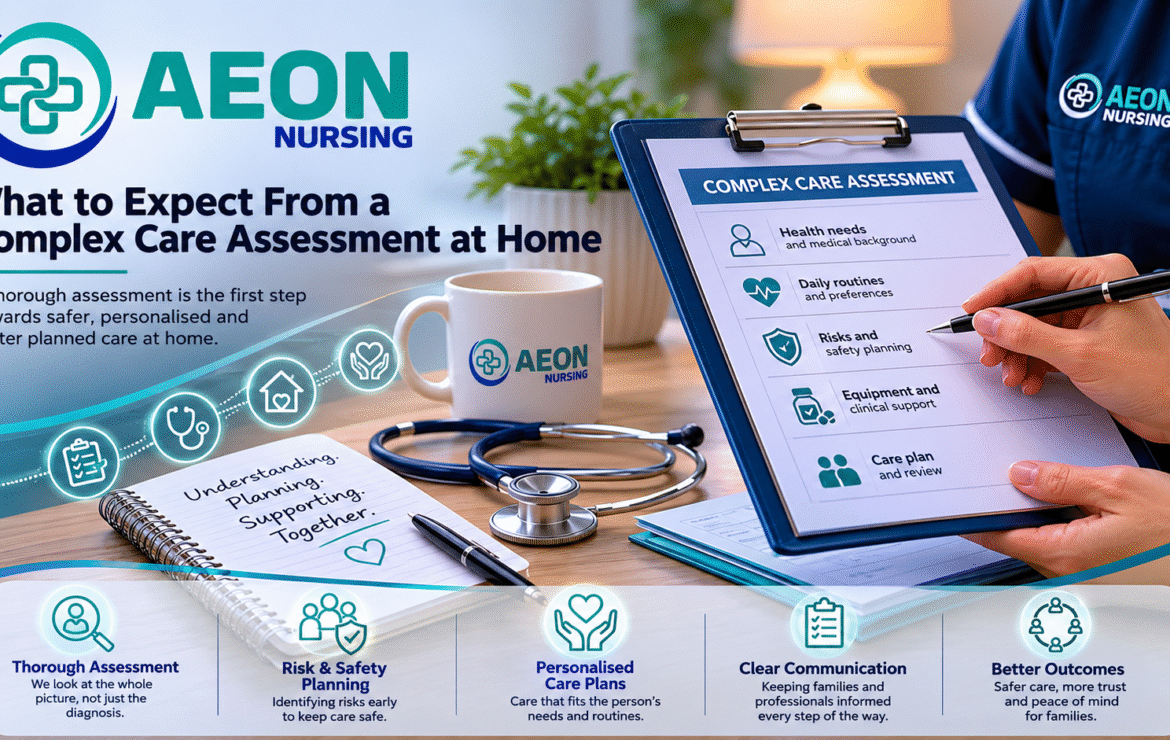
A complex care assessment at home is a conversation and information-gathering process, not simply a form. It should help the person, family and relevant professionals understand current needs, what matters day to day, who is involved and what still needs assessment or a decision.
The right complex care assessment at home is individual. It should not be based only on a diagnosis, a hospital summary or assumptions about what another person needed. The person’s wishes, current circumstances and the advice of relevant professionals matter.
This guide offers seven safe checks to help families and referrers prepare for a complex care assessment at home. It is general planning information only, not medical, nursing, legal, safeguarding, funding or individual care advice.
For related context about settling support into everyday life, see Aeon Nursing’s guide to the first week of live-in care. It is a starting point for questions, not a substitute for an individual assessment.
Step 1: Start with complex care assessment at home goals
A complex care assessment at home should start with the person, not a checklist of tasks. Ask what matters to them: routines, relationships, communication, privacy, culture, faith, work, rest, independence, family life and the outcomes they hope support will make more possible.
A diagnosis or equipment list does not describe the whole person. Families can ask the relevant team to explain the current assessment in everyday language and to distinguish confirmed needs from matters that still need more information.
The CQC person-centred care requirements are a helpful general reference for discussing care that reflects individual needs and preferences.
- Record what matters to the person.
- Ask for plain-English explanations.
- Include day-to-day goals as well as care needs.
- Keep unanswered questions in one place.
Step 2: Build a current picture, not an assumption
A complex care assessment at home should use current information. Needs can change after discharge, a new diagnosis, a change in mobility, family circumstances or a period of recovery. A past document may still be useful, but it should not be treated as the whole picture.
The person and family may have detailed knowledge about what works in daily life. Professional teams may have responsibility for clinical assessment and decision-making. A good discussion values both perspectives without expecting families to make professional judgments.
For context on shared planning, read Aeon Nursing’s article about families, NHS teams and care providers in complex home care.
- Bring the latest relevant documents.
- Explain what has changed recently.
- Separate observations from assumptions.
- Ask what information is still needed.
Step 3: Clarify roles, consent and communication
Complex care at home may involve the person, family, GP, hospital and community teams, therapists, social care, commissioners and a provider. A complex care assessment at home should make clear who is responsible for each area and who coordinates the next discussion.
Consent, privacy and information sharing should be discussed in a way the person can understand. Relevant people need enough information to carry out their responsibilities, but that does not mean every detail has to be shared widely.
The NHS guidance on consent to treatment offers general background. Individual questions should be directed to the professionals responsible for the person’s care and decision-making.
- Ask for named contacts and their roles.
- Confirm who can receive updates.
- Record agreed communication routes.
- Set a date for the next decision or review.
Step 4: Consider the home, routines and practical reality
A complex care assessment at home should consider how support fits into ordinary life. This can include the home environment, access, routines, sleep, family commitments, work, appointments, communication, privacy and the activities that matter to the person.
Practical questions about a home, equipment or a care routine should be discussed with the appropriate professionals. General online information cannot decide what is safe, suitable or required for an individual person.
Aeon Nursing’s article on supporting adults with severe physical disabilities at home gives related context about looking beyond an impairment alone.
- Describe a typical day honestly.
- Identify practical pressures early.
- Keep privacy and relationships in view.
- Ask who considers any specialist home requirements.
Step 5: Check competence, safety and safeguarding boundaries
A complex care assessment at home should not assume that all support is interchangeable. Clear roles, appropriate competence, safeguarding awareness and an agreed route for raising concerns are important parts of a safe, person-centred arrangement.
The CQC requirements for safe care and treatment are a trusted general source for provider-side safety discussions. They do not replace the individual assessment or local policy.
For further context, see Aeon Nursing’s guide to training, governance and safeguarding in complex care.
- Ask what roles are being assessed.
- Do not assume a task can be provided.
- Know how to raise a safeguarding concern.
- Request clarification if boundaries are unclear.
Step 6: Include family, carers and other support
A complex care assessment at home should recognise the people around the person. Family members and informal carers may offer important insight, but they should not be assumed to provide unlimited support or take on responsibilities that are not safe or sustainable.
Talk about rest, work, appointments, relationships, other caring commitments and what support the family can realistically offer. Open conversations help avoid a plan being built on pressures that have not been named.
For a related discussion about support that protects familiar routines, see Aeon Nursing’s guide to respite complex care at home.
- Include the person’s chosen supporters.
- Name what family can realistically sustain.
- Discuss contingency and review routes.
- Keep the person’s wishes central.
Step 7: End complex care assessment at home with clear next steps
A complex care assessment at home should end with clarity about what happens next. Ask what has been agreed, what is still being assessed, who owns each action, what evidence or decision is needed and when the person or family should expect an update.
The NICE guideline on shared decision making is an authoritative resource for the broader principle that people should be supported to take part in decisions about their care. It cannot decide an individual outcome.
A provider can explain whether a service may be suitable. It should not promise a package, named staff, funding, a start date or a specific outcome before assessment, risk review, agreement, staffing and availability have been considered.
- Request a written summary where appropriate.
- Separate confirmed actions from proposals.
- Agree who provides the next update.
- Ask how to request a review if needs change.
Frequently Asked Questions
Does a complex care assessment at home guarantee that care will start?
No. An assessment helps clarify needs and possible next steps. Any arrangement remains subject to appropriate assessment, risk review, agreement, staffing, funding decisions where relevant and local availability.
Who should be included in the assessment?
It depends on the person’s circumstances. The person should be involved as far as possible, alongside the relevant family members and professional teams with roles in their care or support.
Can a family member speak during the assessment?
Yes, where the person wants that and it is appropriate. Family insight can be valuable, while the person’s wishes, consent and privacy should remain central.
What if needs change after the assessment?
Tell the relevant team and ask how a review is requested. A current plan should explain who is responsible for updates and how changes are communicated.
Talk Through the Options
If you are preparing for a complex care assessment at home, bring these questions to the next conversation with the relevant NHS, social-care or provider team. A useful discussion separates what is known, what is agreed and what still needs assessment or a decision.
Aeon Nursing can discuss whether a service may be suitable, but any arrangement is subject to assessment, risk review, agreement, appropriate staffing, funding decisions where relevant and local availability.
Planning a Sustainable Arrangement
A complex care assessment at home is easier to understand when everyone uses the same current information. Ask where the latest assessment summary is held, who updates it and how the person and family will be told about changes.
The person’s communication may take many forms. Families and professionals can work together to notice how someone expresses comfort, worry, choice, pain, tiredness or a wish to be involved in a decision.
Do not assume that an assessment completed in hospital will transfer unchanged to home. Home, hospital, community and social-care settings can have different responsibilities and practical arrangements.
Prepare short questions before meetings: what has been assessed, what is confirmed, what needs a decision, who is responsible and when can the family expect an update?
When a new person joins the support network, information should be introduced in a respectful and proportionate way. The aim is to support understanding without sharing unnecessary private details.
A complex care assessment at home should include ordinary life: relationships, faith or culture, rest, work, privacy, social connection and the activities the person values alongside care needs.
It is appropriate to ask for an explanation or review if the person or family feels unsure. Asking early can help prevent uncertainty becoming a crisis.
A review should consider what the person and family say is working, what is difficult and whether the current arrangement still matches assessed needs and goals.
Different organisations may make different decisions about support or funding. A general article cannot confirm eligibility, provision or a right to a particular service.
Respectful coordination means professionals share the information they are responsible for, families share what they choose about day-to-day life and the person is supported to be heard wherever possible.
A complex care assessment at home can change as needs, circumstances or goals change. Regular, calm review makes it easier to involve the right people before pressure builds.
A safe plan gives the person and family a route for questions and concerns, while recognising that urgent, clinical and safeguarding situations need the appropriate professional or emergency response.
A complex care assessment at home should create space for the person to describe a good day in their own terms. This can reveal priorities that do not appear in a diagnosis, such as timing, privacy, relationships, communication or the way support is introduced.
Families can prepare a short list of practical observations before a meeting. It is usually more helpful to describe what is happening in daily life and what feels difficult than to try to reach a clinical conclusion without the professionals who are responsible for assessment.
Ask how the assessment will be recorded and who can request a correction if important information has been misunderstood. A clear written record can make the next steps more transparent for the person and the people around them.
A complex care assessment at home may involve difficult conversations about changing needs. Being honest about uncertainty does not mean a family has failed; it helps the relevant team understand where more assessment, explanation or coordination may be needed.
When several organisations are involved, ask each one to explain its responsibility in plain language. Families should not be left to guess whether an action belongs with health, social care, education, a commissioner or a provider.
For a child or young person, it may be helpful to compare questions with Aeon Nursing’s guide to complex care at home for children. Every child still needs their own age-appropriate assessment and professional advice.
Assessment conversations should be paced so the person can take part as fully as possible. This may mean arranging communication support, allowing time for questions or agreeing how someone will be represented if they choose to involve a family member or advocate.
A plan can be person-centred without making promises that cannot yet be kept. It is better to record what has been requested, what has been assessed and what decision is awaited than to give false certainty about a service, budget or start date.
A complex care assessment at home should consider the sustainability of the whole arrangement. The practical contribution of family members may change because of work, health, relationships, other children, travel or exhaustion, and it is useful to name that early.
Ask how risks and concerns are reviewed over time. The answer should identify a clear route for the person or family to raise a change and for the relevant professional or provider to decide what happens next.
Individual support may involve sensitive information. A respectful assessment asks what information is relevant, who needs it and how consent will be recorded, rather than treating privacy as an afterthought.
Home is not a clinical setting alone. An assessment should consider how support affects the person’s comfort, identity, ordinary routines and relationships, as well as the more visible practical requirements.
If the assessment feels overwhelming, it is acceptable to ask for a pause, an explanation in different language or a follow-up conversation. Clear understanding is more useful than agreeing to something that the person or family does not feel able to discuss.
A complex care assessment at home is a foundation for conversation and review, not a promise that every uncertainty will disappear. Its value lies in making the next safe, person-centred decision clearer to the people with the right responsibilities.
For immediate danger or a life-threatening emergency, call 999. Other concerns should follow the appropriate contact route in the current plan or be discussed with the relevant professional team.
An assessment conversation can be revisited when new information emerges. Recording the date, the people involved and the agreed actions helps the person and family understand what has changed without assuming that every earlier decision was wrong.
Complex care assessment at home discussions are strongest when questions are welcomed. A person or family member can ask for information to be repeated, explained differently or confirmed in writing if that would make the next decision easier to understand.
The aim is a practical, respectful and reviewable arrangement. It should help everyone understand the person’s current priorities and the next responsible step, while leaving individual clinical decisions with the professionals who are accountable for them.
Before the meeting, the person or family can identify two or three priorities that would make the discussion worthwhile. These might be understanding a recent change, clarifying a role, checking how a review works or making sure an important preference has been recorded.
A complex care assessment at home is most helpful when it leaves a clear record of the next conversation, the people responsible and the route for asking questions. That clarity supports the person and family without pretending that a general guide can decide an individual plan.
For complex care assessment at home conversations, it can help to ask what part of the picture is already clear and what still needs further assessment. Complex care assessment at home works best when the person and family understand the next responsible action rather than being left with general reassurance alone.
A complex care assessment at home should be safe, person-centred and reviewable. It should create a shared understanding of current needs and questions while leaving individual clinical, safeguarding and funding decisions with the appropriate responsible professionals.
Important Information
This article is general information only and does not replace personalised medical, nursing, legal, safeguarding, funding or social-care advice. Every person needs assessment by the relevant professionals.
Any care from Aeon Nursing is subject to assessment, risk review, agreement, appropriate staffing, funding decisions where relevant and local service availability. For immediate danger or a life-threatening emergency, call 999.
About the Author
Content Writer: Dr Naeem Aslam
Write a Comment