Accessible Information in Home Care: What Families Can Ask For

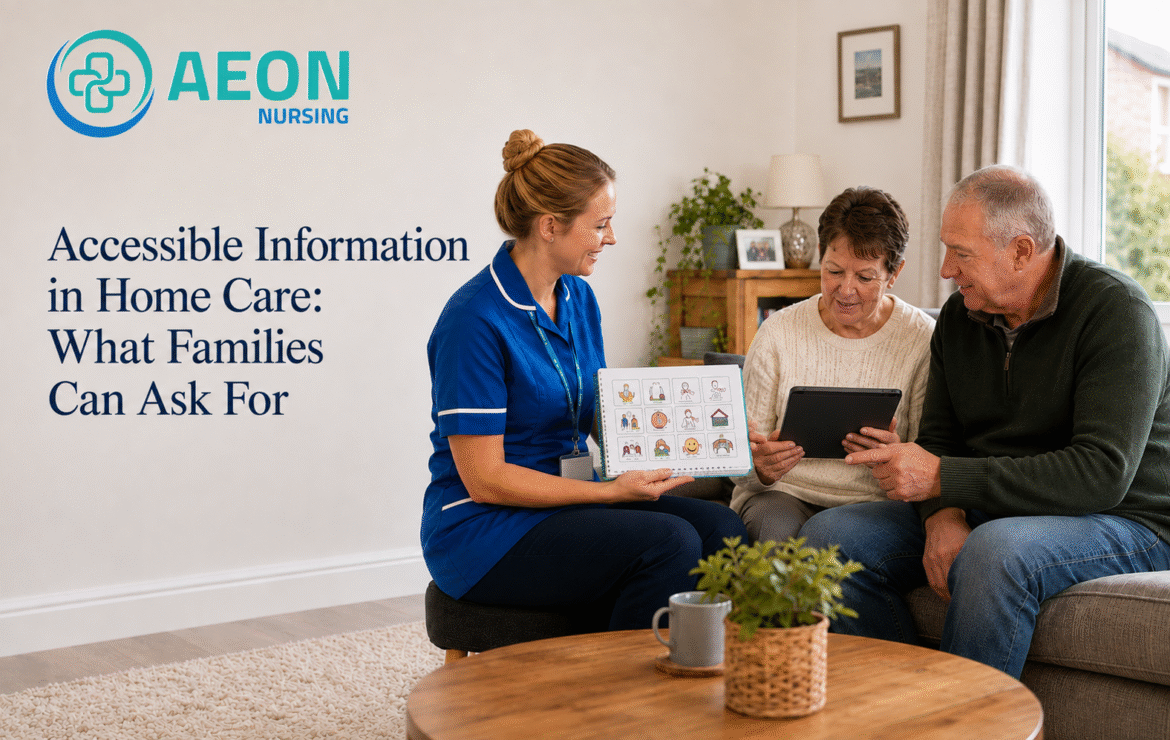
Accessible Information Standard in home care questions should begin with the individual: what information and communication support do they need to understand, participate and make choices? The NHS England Standard uses a consistent process to identify, record, flag, share, meet and review needs associated with a disability, impairment or sensory loss.
The Standard does not mean one format suits everyone, and it does not replace an individual communication assessment. This guide turns its requirements into practical family questions for assessment, care planning, visits and review. Any statement about Aeon Nursing’s current systems must be confirmed by Aeon before publication.
Accessible Information Standard in Home Care: What It Means
The current NHS England Accessible Information Standard requirements explain how the Accessible Information Standard in home care uses a process for identifying, recording, flagging, sharing, meeting and reviewing information and communication support needs. It covers people with a disability, impairment or sensory loss and also recognises relevant needs of families and carers.
The Accessible Information Standard in home care can affect assessment, consent, care-plan explanations, appointment details, medicines information, complaints, emergency planning and routine communication. A provider needs enough specific information to deliver the agreed support without turning a disability label into an assumption about the person.
Aeon’s About Aeon Nursing page gives organisational context. Families should ask how accessibility is implemented in real records and visits: who asks, where the answer is recorded, how workers see it, who arranges support and how the person can say that an adjustment is not working.
Step 1: Ask How the Person Prefers to Receive Information
When applying the Accessible Information Standard in home care, ask the person directly where possible. They may prefer large print, easy read, British Sign Language, braille, audio, email, text, a communication aid, extra time, plain language or help from a chosen supporter. Preferences may differ by task: a short appointment reminder may work by text while a care-plan review requires an interpreter or accessible document.
Record the outcome the adjustment is intended to achieve. “Needs large print” is more useful when it also identifies the required font size and document type. “Uses an interpreter” needs the language, communication method and booking arrangement. Avoid vague phrases such as “communication difficulty”.
Families exploring complex care for adults can bring an existing communication passport or profile to assessment. The provider should still confirm that it is current and ask the person how it should be used and shared.
Step 2: Identify Communication Needs Without Assumptions
Under the Accessible Information Standard in home care, a diagnosis can prompt a question but should not determine the answer. Two people with the same sensory impairment, neurological condition or learning disability may use different formats, devices, signs, supporters and communication rhythms. Ask what helps, what creates barriers and how the person shows agreement, uncertainty, discomfort or refusal.
NHS England’s implementation guidance for the Standard encourages specific descriptions that lead to specific support. The assessment should consider both information the organisation sends and two-way communication during care.
For children and young people, use age-appropriate communication and involve parents or others within the lawful care arrangement, while keeping the child or young person involved as much as possible. Aeon’s children’s complex-care information can help frame service questions, but the individual plan must provide the detail.
Step 3: Record the Needs Clearly and Specifically
For the Accessible Information Standard in home care, a useful record says what the person needs, when, and how staff provide it. It can note preferred contact method, accessible format, communication aid, interpreter requirements, quiet environment, processing time, supporter involvement and how the person confirms understanding. It should identify who arranged any external support and what to do if it is unavailable.
Record the person’s own words where helpful. Distinguish a preference from an essential adjustment and identify any safety relevance. Do not copy unnecessary medical detail into general notes simply to justify an adjustment. The purpose is to remove a communication barrier, not to create a second clinical record.
Aeon describes its clinical expertise and oversight online. Ask who reviews communication information when clinical instructions are involved and how staff avoid reinterpreting an instruction they are not authorised to change.
Step 4: Flag Needs So Relevant Staff Can See Them
For the Accessible Information Standard in home care, a communication need hidden in a long assessment is unlikely to work consistently. The record system should make relevant information visible to authorised workers at the point they prepare for or deliver care. A flag should prompt staff to read the specific instruction rather than expose unnecessary personal information.
Ask whether the flag appears across the relevant parts of the record, how updates replace old information and what happens when temporary or new staff are involved. The person should not have to repeat an established need at every contact because systems are disconnected.
Visibility must be balanced with confidentiality and security. Staff should see what they need for their role, while access and sharing remain controlled. A visible flag is not permission to disclose information outside the agreed or lawful process.
Step 5: Share Needs Appropriately with Consent and Safeguards
Applying the Accessible Information Standard in home care may require communication needs to travel between a home-care provider, NHS service, social-care professional, family member or advocate so the person can participate safely. Ask what will be shared, with whom, for what purpose and through which secure route. Record the person’s preferences and any relevant lawful basis or authority.
CQC’s Regulation 9 guidance requires person-centred care, involvement and reasonable adjustments. It does not remove confidentiality obligations. Share relevant communication information without treating a family relationship as automatic access to every record.
A care plan can also state what must accompany the person to an agreed appointment or hospital visit. That might include a communication passport or essential accessible information. Confirm responsibility and consent before the event rather than discovering the gap at the appointment.
Step 6: Provide the Agreed Format or Communication Support
For the Accessible Information Standard in home care, recording a need is not the outcome. Check that the accessible document, interpreter, communication aid, longer appointment or other support is actually arranged. Staff should know how to access the resource and what to do when a planned adjustment fails.
Reasonable adjustments are also recognised in the Equality Act 2010. Whether a particular adjustment is legally required depends on the circumstances, so this article does not decide individual legal duties. It does support a practical question: what barrier exists and what effective step can be taken?
A family can review Aeon’s Who We Help page before an enquiry, then ask which formats, interpreter routes or communication supports Aeon can currently arrange. Marketing should not promise every format instantly; the provider should explain timescales and any external coordination honestly.
Step 7: Review Whether the Adjustment Is Actually Working
Reviewing implementation of the Accessible Information Standard in home care means asking whether the information is understandable and whether the person can participate as intended. A format may be technically provided but still fail: the print may be too small, easy-read wording may not suit the person, an interpreter dialect may be wrong or a digital message may be inaccessible on the person’s device.
Record feedback, the change agreed, who will implement it and when it will be checked. Review also when sight, hearing, cognition, dexterity, language, equipment or supporter availability changes. Do not leave a known failed adjustment on the record as if the requirement has been met.
The Aeon Nursing articles hub can support wider planning. The individual’s current communication information, professional advice and the organisation’s verified accessible-information process remain the controlling sources.
Examples of Specific, Useful Recording
- “Send appointment information by email in 18-point Arial; telephone changes should also be texted.”
- “Book a registered British Sign Language interpreter for care-plan reviews; do not use a relative as the default interpreter.”
- “Offer information in short sections, allow processing time and ask the person to explain the next step in their own words.”
- “Use the current communication passport stored in the care plan and take the agreed copy to appointments.”
These are examples, not universal prescriptions. The person must define what works for them, and specialist assessment may be required. Avoid copying an example into a care plan without confirming it.
Accessible Information Standard in Home Care: When a Need Is Missed
A missed need can appear as a late interpreter booking, a letter the person cannot read, a telephone call when text was requested, an inaccessible consent form or a worker who has not seen the communication profile. Record the actual barrier and its consequence without blaming the person for being “hard to contact” or “not engaging”.
Take the immediate practical step available within the person’s plan: rearrange communication in the agreed format, seek an interpreter or specialist, pause a non-urgent decision if the person cannot participate, and escalate any safety concern. A worker should not ask a relative to interpret confidential or complex information by default simply because arranging formal support takes time.
The follow-up should look beyond the single event. Was the need identified but not recorded, recorded but not flagged, flagged but unavailable to the worker, or visible but not acted upon? Each failure points to a different system correction. Update the active record, not merely an incident note, and tell the person what will change.
If the provider and another service hold different communication information, confirm the current position with the person and share an authorised update. Do not leave contradictory formats or supporters listed across records. A review should identify the owner and completion date for every corrective action.
Accessible Information Standard in Home Care Across the Care Journey
At first contact, the organisation needs a simple way to ask about communication and provide service information accessibly. During assessment, it needs enough detail to understand the person’s needs, preferences and choices. Before care starts, relevant workers need the specific instructions, resources and any external bookings.
During visits, staff should use the agreed method and check that communication remains two-way. At reviews, complaints, incidents and transitions, the person should receive information and an opportunity to contribute in a usable format. Accessibility is not a specialist add-on reserved for formal meetings; it affects ordinary dignity and control.
When appointments or hospital transfers are involved, agree who carries or sends a current communication passport, who confirms receipt and how the home-care team learns about changes. Sharing must remain necessary, proportionate and secure. “The hospital has it” or “the family will explain” should not substitute for a named handover action.
Before ending a service, provide relevant final information in the person’s preferred format and agree any lawful transfer to the next team. This reduces the risk that established needs disappear during a provider or service change.
Ask who monitors the end-to-end pathway. Auditing only whether a field is completed will not show whether accessible information reached the person or enabled meaningful participation. Feedback from people using the service should inform corrective action and training.
Seven Questions Families Can Ask a Home-Care Provider
- How do you identify information and communication needs during assessment?
- Where are specific needs and formats recorded?
- How are they flagged to every relevant authorised worker?
- How do you share them safely across the care network?
- Who arranges interpreters, accessible documents or communication aids?
- What happens if an agreed adjustment is unavailable or fails?
- How and when do you ask the person whether the support works?
How Aeon Nursing May Help
Aeon Nursing may be able to discuss how the Accessible Information Standard in home care relates to the person’s communication needs during assessment and explain how agreed information would be recorded and used within a home-care arrangement. Exact capabilities, formats, external services and timeframes require confirmation for the proposed package.
Aeon should not assume one adjustment suits a diagnosis or claim compliance merely because a field exists in a record. Families can ask for a specific pathway from identification through to review.
Frequently Asked Questions
Who does the Accessible Information Standard in home care support?
It addresses information and communication support needs associated with a disability, impairment or sensory loss, including relevant needs of patients or service users and their families or carers. Individual needs must still be identified rather than inferred.
What kinds of communication needs can be recorded?
Examples include accessible formats, interpreter or communication-professional requirements, preferred contact method, communication aids, processing time and support for two-way conversation. The description should be specific enough to lead to action.
Can communication needs be shared with family members?
They may be shared when this is appropriate and lawful, taking account of the person’s wishes, consent, confidentiality and any relevant authority. Family relationship alone does not create automatic access to all information.
What should happen if an agreed format is not working?
Tell the provider, record the barrier and ask for a review. The person should be involved in identifying a better adjustment, with specialist support where needed. A failed format should not remain recorded as if the need is met.
Talk Through the Communication Questions
Contact Aeon Nursing to discuss communication and accessible-information needs that may affect a proposed home-care assessment. Bring any current communication passport, preferred-format details or professional recommendations so they can be checked with the person.
Important Information
Accessibility and compliance review are required before publication. This article provides general information based on official sources checked on 14 August 2026. It is not legal, clinical, data-protection or communication-assessment advice and does not decide whether a specific adjustment is legally required or clinically appropriate. Verify the current Standard and obtain individual professional or legal advice where needed.
About the Author
Author & Content Writer: Dr Naeem Aslam
Last updated: August 2026
Write a Comment