Why Training, Governance and Safeguarding Matter in Complex Care at Home

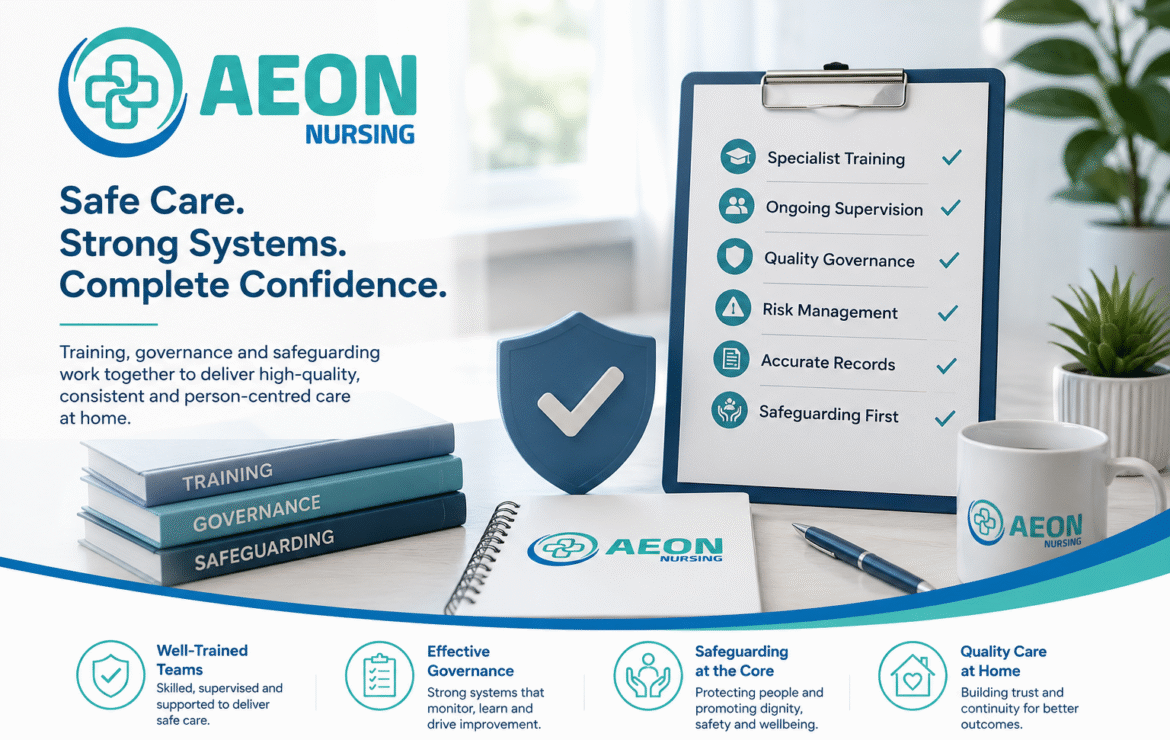
Why Training, Governance and Safeguarding Matter in Complex Care at Home
When families choose complex care at home, they often focus first on the visible parts of care. They think about kindness, consistency, reliability, and whether the team will be the right fit. Those things matter a great deal. But behind safe and consistent care sits something less visible and just as important: training, governance, and safeguarding.
These are not empty compliance words. They are the systems that help make care safer, more accountable, and more reliable when needs are complex. In a home setting, where care may involve medication routines, specialist equipment, mobility risk, feeding support, children’s needs, or changing health conditions, these systems matter even more.
CQC Regulation 17 says providers must operate effective systems and processes to assess, monitor, and improve the quality and safety of services. CQC Regulation 18 says providers must deploy enough suitably qualified staff. Together, these rules make a simple point: good care depends on good systems as well as good intentions.
Why Training Matters in Complex Home Care
Complex home care is rarely one fixed task. It often involves a changing mix of daily support, clinical routines, communication, family coordination, and risk management. The more complex the person’s needs, the more important staff competence becomes.
CQC Regulation 18 says providers must deploy enough suitably qualified staff and make sure staff receive the training, support, supervision, and development they need to carry out their role effectively.
That matters because complex care is not generic. A provider supporting someone with a tracheostomy, PEG feeding, seizures, high dependency needs, neurological conditions, or behavioural complexity should not rely on general induction alone. Training must reflect the actual person and the actual risks involved.
This is one reason Aeon Nursing’s Our Expertise page is relevant. It presents nurse-led care, clinical oversight, and quality systems as part of the service model rather than as an afterthought.
Good Training Is Not a One-Off Exercise
Families sometimes think training means a single introduction before staff start work. In reality, good training is ongoing. It includes induction, supervised practice, refresher learning, competence checks, and specialist development as needs change.
The Care Certificate is recognised as the minimum induction standard for workers entering the care sector. That is helpful, but complex home care often requires more than minimum induction. It requires role-specific and person-specific competence too.
This matters because needs change. A person’s condition may become more unstable. Equipment may change. Risks may increase. Good providers respond by updating training and reviewing competence, not by assuming previous learning is always enough.
Why Governance Matters Behind the Scenes
Governance can sound abstract, but in practice it is highly practical. It is about how a provider knows care is safe, consistent, and improving.
CQC Regulation 17 says providers must operate effective systems and processes to monitor service quality, identify risks, maintain records, and act on learning.
In a complex home care setting, governance may include:
- care plan reviews
- audits and spot checks
- incident reporting and learning
- supervision and competence checks
- medication oversight
- escalation processes
- accurate documentation
Families may not see most of this directly, but these systems are part of what keeps care safer and more consistent.
Aeon Nursing’s compliance checklist is useful here because it reflects the point that compliance is not separate from care quality. It is one of the structures that supports it.
Governance Protects Continuity
One common misunderstanding is that governance exists only to satisfy regulators. In reality, it protects continuity for the person receiving care.
Good governance helps make sure that if staff change, the care plan stays clear. If risks increase, the plan changes. If an incident occurs, the provider reviews it, learns from it, and reduces the chance of repeat harm.
This is especially important in home care, where families may not have a hospital team nearby. Strong systems help create stability in a setting that is more dispersed and less visible than institutional care.
Readers who want the wider context may also find it useful to read what complex care at home means because governance is one of the hidden structures that makes that model work properly.
Safeguarding Must Stay Central
Safeguarding is not a side issue. It sits at the centre of safe care. This includes protecting adults and children from abuse, neglect, poor practice, exploitation, and unsafe systems.
The Care Act statutory guidance created a framework for adult safeguarding and includes measures to guard against provider failure and to protect continuity of care.
That is important because safeguarding is not only about reacting after harm. It is also about reducing risk through better records, better supervision, better training, clearer escalation, and a culture where concerns can be raised early.
Safeguarding in Home Care Can Be More Complex Than Families Realise
Home care creates a different environment from a hospital or residential setting. Care takes place in someone’s private home. Family members may be heavily involved. Staff may work one-to-one or in small teams. Some people being supported may have communication difficulties or high dependence.
That makes safeguarding systems even more important.
CQC’s safeguarding quality statements emphasise the importance of partnership working, sound thresholds, and making safeguarding personal. Skills for Care also emphasises safeguarding records, training, and whistleblowing.
For families, this means asking sensible questions:
How are concerns reported?
How are staff supervised?
How are incidents reviewed?
How does the provider learn from mistakes?
These are not awkward questions. They are important quality questions.
Why Families Should Ask About Governance Before Care Starts
Many families ask about cost, availability, and whether a provider can meet the person’s needs. Those questions matter, but they should also ask about the systems behind the care.
Useful questions include:
- How do you train staff for this level of care?
- How do you assess competence?
- How often do you review care plans?
- What happens if something goes wrong?
- How are safeguarding concerns handled?
- How do managers or nurses oversee the team?
These questions matter even more where care involves children, specialist routines, or higher-acuity needs.
Families may also find Aeon Nursing’s Our Services page useful because it places live-in care, complex care, children’s care, and discharge support inside one quality-led and nurse-supervised framework.
Governance Supports Person-Centred Care Too
Some people hear “governance” and worry it will make care feel rigid or impersonal. Good governance should do the opposite. It should protect person-centred care by making sure the person’s preferences, routines, risks, and goals are clearly understood and followed consistently.
The Care Act statutory guidance places strong emphasis on wellbeing and on outcomes that matter to the individual. Training, safeguarding, and governance are not separate from that principle. They help make it possible in daily care.
When records are accurate, reviews are timely, and staff understand the person well, care usually feels more personal, not less.
Why This Matters So Much in Complex Care at Home
The more complex the care, the less room there is for weak systems. A person who needs PEG feeding, seizure support, ventilation, close medication oversight, or high-dependency support at home needs more than a caring team. They need a provider whose training, governance, and safeguarding systems are strong enough to support that reality.
Aeon Nursing’s public materials repeatedly describe its model as clinically led, person-centred, and supported by training, governance, and quality oversight. You can see that reflected across Our Expertise, Our Services, and the compliance checklist.
That makes this topic highly relevant for the Aeon Nursing audience. Families are not only choosing who will deliver care. They are also choosing how safety, quality, and accountability will be maintained behind the scenes.
How Aeon Nursing Can Help
Aeon Nursing presents itself as a nurse-led provider of live-in care, adult and children’s complex care, discharge support, and palliative care across the UK. Its website also highlights governance, training, and quality oversight as part of service delivery.
For families, that can provide reassurance. It suggests the provider is thinking not only about compassionate care, but also about how the service stays safe, accountable, and fit for complex needs over time.
Need Help Understanding Quality in Complex Home Care?
If you are comparing providers or trying to understand what safe, well-governed home care should look like, professional guidance can make a significant difference.
For a no-obligation discussion, contact
info@aeonnursing.co.uk
You can also visit our blog page:https://aeonnursing.co.uk/blog/
Important Information
This article is for general information only and does not replace legal, regulatory, or professional advice. Training, governance, and safeguarding requirements vary by service type and care context, but all providers should meet applicable regulatory standards and ensure their systems reflect the people they support. CQC Regulation 17 says providers must operate effective systems and processes, and that remains a useful principle for families to keep in mind when choosing a provider.
Author & Content Writer: Dr Naeem Aslam
Write a Comment