
Disability Rights in Home Care: Dignity, Choice and Reasonable Adjustments

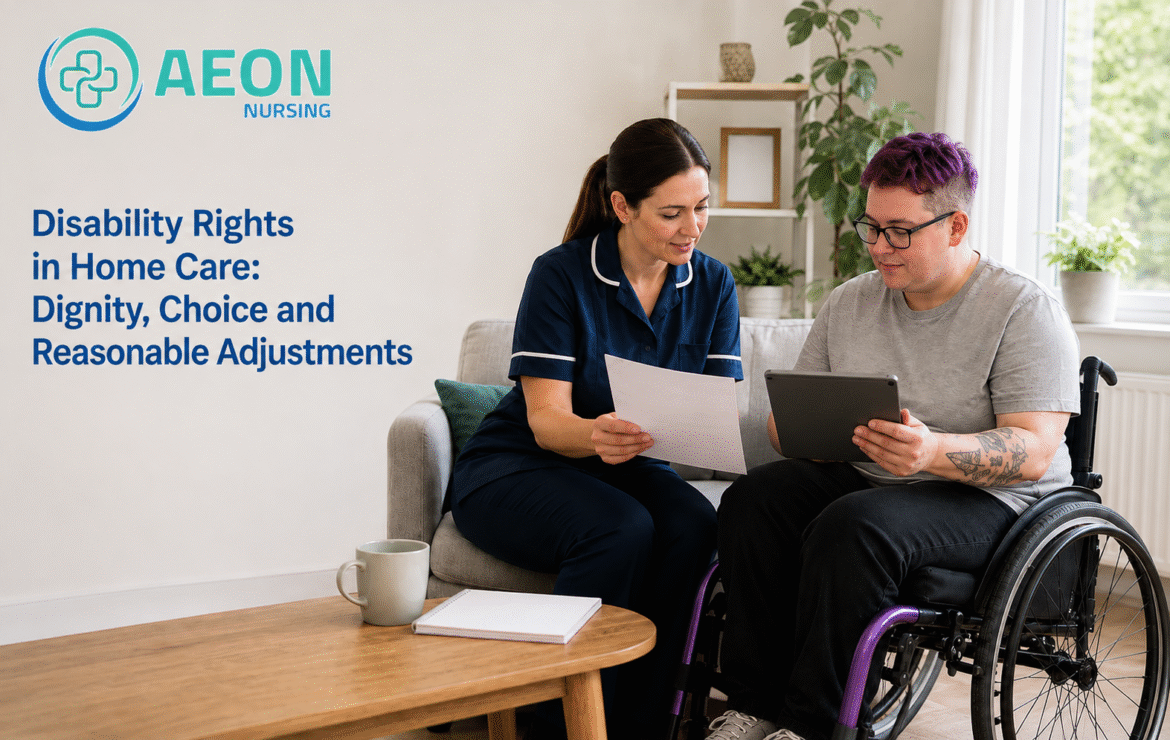
Disability rights in home care should be visible in everyday practice: the person can access the service, understand and communicate, make choices, retain privacy and dignity, and receive reasonable adjustments where the legal duty applies. Good intentions are not enough if a barrier remains.
No single adjustment suits every disabled person, and this guide cannot decide an individual Equality Act dispute. It turns official equality and CQC expectations into practical questions for assessment, care planning, visits and review.
Disability Rights in Home Care: From Principle to Practice
The Equality Act 2010 protects disabled people from unlawful discrimination and includes a duty to make reasonable adjustments in relevant circumstances. The duty is anticipatory for service providers: organisations should think ahead about barriers disabled people may face, while also responding to individual needs.
The government’s Equality Act guide for service providers explains the reasonable-adjustment duty in accessible terms. What is reasonable depends on factors including effectiveness, practicality, resources and circumstances; a marketing article cannot decide the legal answer for one case.
The About Aeon Nursing page gives provider context. Any claim about Aeon’s facilities, formats, training or adjustment process must be checked against current operations and evidence before publication.
Step 1: Ask the Person What Access or Communication Barrier Exists
For disability rights in home care to be meaningful, start with the person’s experience. Ask what makes it harder to enquire, be assessed, enter or use the service, understand information, communicate choices, receive care safely or participate in reviews. Barriers may be physical, sensory, cognitive, communication-related, digital, procedural or attitudinal.
A diagnosis can prompt exploration but does not prescribe an answer. Two people with the same impairment may need different formats, equipment, environments, visit times, communication methods or support. Avoid asking a relative to define the person before speaking with the person using suitable communication.
CQC’s equity in access quality statement focuses on understanding local populations and reducing inequalities in access and experience. For an individual enquiry, a provider should be able to explain how it identifies and responds to barriers rather than relying on a generic equality statement.
Aeon’s Who We Help information may help a person prepare questions. It should not be treated as an exhaustive eligibility list or evidence that every adjustment can be provided without assessment.
Step 2: Record the Effect on Care, Choice and Participation
A disability rights in home care plan should describe the barrier functionally. “Visual impairment” is less actionable than “cannot read the standard-size care-plan print and needs electronic text compatible with screen-reading software”. “Anxious” is less useful than identifying which environment, communication or timing makes participation difficult.
Record when the barrier occurs, what the person is trying to do, the consequence, support already used and the outcome they need. Distinguish an essential safety or access requirement from a preference, while respecting both in person-centred planning.
Information should be relevant and proportionate. Staff do not need every medical detail to implement an accessible format or communication method. Protect confidentiality and explain who will see the adjustment record.
For adult complex care at home, connect access needs with equipment, positioning, fatigue, communication, appointments and emergency planning. The care plan should show how the person can express pain, refusal, uncertainty or a change from their usual presentation.
Step 3: Explore Reasonable Adjustment Options with the Person
Disability rights in home care may require changing a policy or procedure, providing an auxiliary aid or service, or addressing a physical feature where relevant. Examples can include accessible documents, interpreter or communication-professional support, longer or differently timed assessment, a communication aid, alternative contact method or modification of how a routine is delivered.
Explore more than one option where appropriate. The person may prefer a solution that achieves independence without relying on a relative. Consider effectiveness, safety and sustainability. Do not charge a disabled person for a reasonable adjustment where the legal duty prevents that; seek current legal advice for the individual position.
CQC’s Regulation 9 person-centred-care guidance requires providers to work in partnership with the person and make reasonable adjustments where needed. Disability rights in home care must also sit alongside safety and other legal duties, with any genuine conflict explained and alternatives explored.
Aeon’s clinical expertise information can prompt questions about specialist input. A clinical recommendation may inform an adjustment but should not erase the person’s preferences or be presented as the only possible approach without discussion.
Step 4: Agree Who Will Act and by When
For disability rights in home care, turn the agreed adjustment into an action: what will be provided or changed, who owns it, by when, where it is recorded, who needs to know, any training or external booking required and the backup if it is unavailable.
Flag relevant information so authorised workers see it before the visit. A requirement hidden in a long assessment may fail in practice. The flag should link to specific instructions and avoid exposing unnecessary sensitive information.
If the adjustment depends on another organisation—such as an interpreter, equipment supplier, landlord, NHS team or commissioner—name the contact and confirmation point. The provider should not promise something outside its control, but it should coordinate its responsibilities and explain any dependency.
For children’s complex care, include age-appropriate participation, education settings, family knowledge and relevant professionals. Disability rights and reasonable adjustments apply alongside safeguarding, parental responsibility, consent and evolving capacity.
Step 5: Protect Privacy, Dignity and Everyday Control
Disability rights in home care are visible in ordinary choices: when to get up, what to wear, how personal care is provided, who enters the room, preferred food, relationships, activities, communication and acceptable risk. Care should not become unnecessarily restrictive because a disabled person needs support.
CQC’s public guide to good home-care agencies describes expectations including respect, involvement, safety, suitable staff and the ability to complain. These are useful questions for families, not a guarantee about a provider before assessment.
Ask before touching equipment, moving items, entering private space or involving another person. Explain tasks in the person’s accessible format and seek consent. Avoid speaking about the person as if they are absent, even when communication takes longer.
People may choose options professionals consider unwise. The response depends on capacity, risk, law and the service agreement. Use shared decision-making and proportionate risk planning rather than removing choice automatically. Seek appropriate professional advice for complex decisions.
Step 6: Check Whether the Adjustment Works in Practice
For disability rights in home care, an adjustment is not complete because it appears in a policy or record. Ask the person whether it removed the barrier and observe the intended outcome: could they understand, communicate, enter, participate or receive care as planned?
Test the full pathway. An accessible care-plan document may work, but appointment changes may still arrive by an unusable phone call. An interpreter may be booked for assessment but not review. A ramp may provide access while the visit schedule ignores fatigue or treatment timing.
Record feedback and any amendment. If a staff member did not implement the adjustment, examine why: missing flag, inaccessible equipment, lack of training, workload, unclear responsibility or refusal. The correction should match the cause.
The Aeon Nursing articles hub can support wider questions, but evidence must come from the person’s actual experience and the active care record.
Step 7: Review and Escalate Unresolved Barriers Appropriately
Review disability rights in home care arrangements after changes in disability, health, communication, equipment, home environment, staff or service design. A previously effective adjustment can stop working. Build review triggers into the plan rather than waiting for repeated failure.
If the provider cannot supply the preferred adjustment, ask for its reason, evidence and alternative options. A reason should be specific to the circumstances. Cost or inconvenience alone should not be used as an automatic answer; the legal test requires proper consideration.
Use the provider’s accessible complaints route for unresolved service issues. Depending on the facts, a commissioner, CQC, Ombudsman, Equality Advisory and Support Service or independent legal advice may also be relevant. Each body has a different remit, and urgent safety or safeguarding concerns need immediate action.
Record the unresolved barrier, impact, interim control, escalation owner and next date. Do not leave the person without a workable care arrangement while organisations debate responsibility.
Disability Rights in Home Care: Barriers and Questions
| Barrier | Useful question |
|---|---|
| Standard documents cannot be read | Which format, font or digital compatibility enables independent access? |
| Telephone-only contact is inaccessible | Can contact and authentication work securely by text, email or relay? |
| Assessment is too rushed for communication | What timing, environment or communication support enables participation? |
| Workers do not see the adjustment | Where is it recorded and flagged before each visit? |
| A relative is used as default interpreter | When is a qualified communication professional required and who books them? |
| Equipment changes restrict daily choice | How can safety be achieved while preserving control and routine? |
These examples are starting points, not universal legal answers. The person, provider and relevant professionals should identify an effective, safe and lawful approach.
Disability Rights in Home Care Across the Care Journey
At first contact, offer more than one usable communication route and ask about access needs before scheduling assessment. A telephone-only enquiry route may exclude someone who cannot use voice calls, while a digital-only form may create another barrier. Explain how identity checks can be completed accessibly and securely.
During assessment, consider the environment, length, timing, format and support needed for meaningful participation. An adjustment may involve shorter sessions, breaks, a quiet room, an interpreter, a communication aid, home positioning or accessible written information. Record what worked so the person does not have to negotiate it again at every contact.
Before care starts, ensure the active care plan, rota and worker briefing reflect agreed adjustments. Confirm any equipment, external professional, accessible record or travel arrangement. A proposed start date should not override an essential access condition that remains unresolved.
During visits, protect choice rather than reducing the person to a task list. Ask how assistance should be provided, keep communication two-way and respect additional processing time. Where an adjustment affects a clinical or moving-and-handling method, obtain authorised professional advice rather than asking the worker to invent a workaround.
At appointments, reviews and complaints, book the required support early and send information in the agreed format. Confirm that the person can contribute, not merely attend. If a representative is involved, continue addressing the person directly and clarify the representative’s role.
During hospital discharge or provider transition, transfer relevant accessibility information lawfully and confirm receipt. Mark versions and remove obsolete instructions. An established adjustment should not disappear because an organisation changes.
When a service ends, provide final information and complaint or records routes accessibly. Invite feedback about barriers across the whole journey. Audit whether adjustments were delivered and effective, not only whether a form field was completed.
Service-level review should look for patterns: abandoned enquiries, missed appointments, repeated communication failures, complaints about access and differences in experience. Use proportionate equality information and direct feedback lawfully. A pattern may reveal a barrier that no single complaint described fully.
Disability Rights in Home Care: Seven Questions About Adjustments
- What barrier does the person identify?
- How does it affect access, communication, safety, dignity or choice?
- Which options could remove or reduce it effectively?
- Who will implement the agreed adjustment and by when?
- How will workers protect privacy and everyday control?
- How will the person confirm whether the adjustment works?
- What review and escalation route applies if it remains unresolved?
How Aeon Nursing May Help
Aeon Nursing may be able to discuss disability rights in home care by identifying access and communication needs during enquiry and assessment, discussing possible adjustments and recording agreed actions for a proposed service. Exact options and timeframes depend on individual assessment, safety, law and available resources.
Aeon should not speak for all disabled people, promise every requested measure automatically or decide a legal dispute in marketing content. It should show an evidence-based process and listen to the person.
Frequently Asked Questions
What can disability rights in home care require as a reasonable adjustment?
It may involve changing a procedure, providing an aid or service, an accessible format, communication support, different assessment arrangements or another effective step. What is reasonable depends on the individual circumstances.
Who should identify communication or access needs?
The provider should ask proactively, and the person should lead the description of what works where possible. Families and professionals may contribute with consent or lawful authority, but diagnosis alone should not determine the answer.
Does the same adjustment work for every disabled person?
No. Needs, preferences, environments and outcomes differ. The adjustment should be specific, recorded, implemented and reviewed with the person.
How can an unresolved access barrier be raised?
Use the provider’s accessible complaints and escalation routes, documenting the barrier, impact, options tried and desired outcome. External equality, commissioning, regulatory, Ombudsman or legal routes may be relevant depending on the facts.
Talk Through Access and Communication Needs
Contact Aeon Nursing to discuss disability rights in home care and barriers that may affect a proposed assessment or service. Share the outcome needed and any current professional recommendations, while asking Aeon to confirm what it can provide through its assessed process.
Important Information
Equality-lead and legal/compliance review are required before publication. This is general England-only information from official sources checked on 14 August 2026. It is not legal, equality, clinical, safeguarding or reasonable-adjustment advice and does not determine whether a particular adjustment is required in an individual case.
About the Author
Author & Content Writer: Dr Naeem Aslam
Last updated: August 2026
Write a Comment